Law firms get cited in Google's AI Overviews by publishing pages Google can crawl, index and show with a snippet, and by making those pages useful enough to support an answer. No schema, file, tool or agency can guarantee a citation.
AI Overviews for law firms are an SEO question first. Google's AI features draw on its Search systems, so the work overlaps with what strong firms already do. This guide separates what Google has documented from what research suggests and what is only being sold. It also shows how to tie search and answer engine visibility to qualified inquiries and new clients.
The short version
- A page must be indexed and eligible to show with a snippet. That makes it eligible, not selected.
- A strong ranking helps but doesn't settle it. Many cited pages sit outside the first 10 results for the same search.
- Original answers from practicing lawyers give Google more to use than a rewrite of common advice.
- Skip special AI files, AI schema and tools that claim to predict citations.
- Track citations, but judge the work by qualified inquiries, consultations and new clients.
What are Google AI Overviews, and why should law firms care?
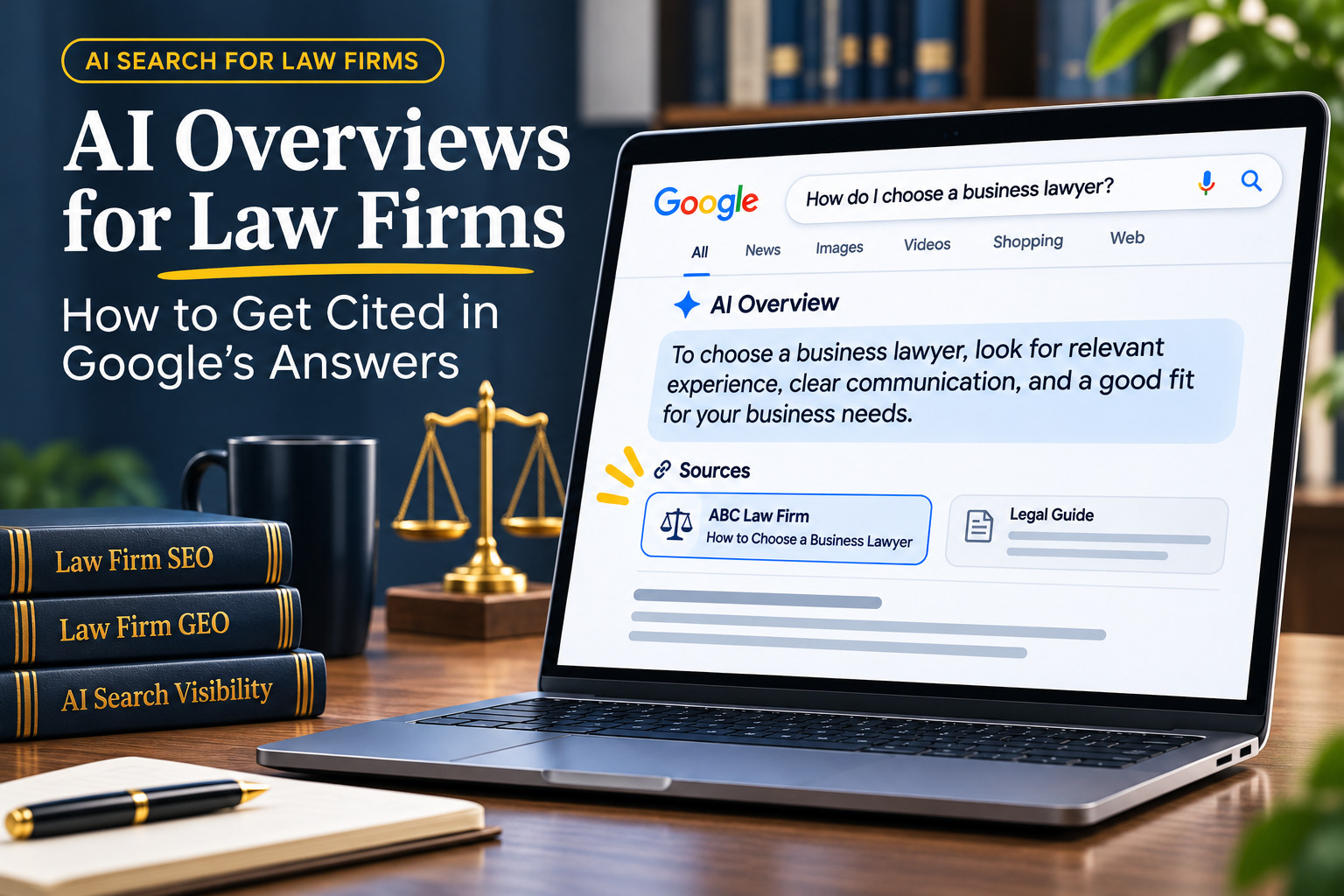
An AI Overview is an AI-generated summary in Google's results, with links to supporting websites. Google says it shows one only when it adds something to classic Search, and that often it doesn't appear.
| Traditional results | AI Overviews |
|---|---|
| Show individual pages to compare | Give a written summary with supporting links |
| Appear whether or not an Overview does | Appear only for some searches |
| Report clicks, queries and position in Search Console | Share those figures with web search, with a separate report for impressions |
AI Overviews sit alongside the regular results, not in place of them. AI Mode is a separate, more conversational experience for deeper questions and comparisons. Google says the two may use different models and techniques, so a page can appear in one and not the other.
Where AI Overviews appear for legal searches
They appear far more often on questions than on searches for a firm. Ahrefs found them on 23.6% of 1.5 million legal keywords in desktop data from September 2025. Local searches across all topics triggered them just 7.9% of the time.
A smaller May 2025 test by Whitespark shows the same split. Across 540 searches in six local industries, including personal injury law, AI Overviews appeared on 15% of searches such as "personal injury lawyers in Phoenix." They appeared on 92% of informational questions in that test.
The two figures measure different keyword sets, so neither is a benchmark for your practice area. The pattern is still useful. AI Overviews mostly touch the research stage, while map results still lead many service-and-city searches. A business-facing firm, where buyers often research a narrow legal question, may see this earlier than a firm that wins most work through local searches.
What AI Overviews do to clicks
The bad news is that they appear to reduce clicks. A randomized study of 1,065 desktop Chrome users in early 2026 found that hiding AI Overviews raised organic clicks from 0.37 to 0.62 per affected search. Showing them cut clicks by 39.8%. The paper is a working draft, not yet peer reviewed, and it isn't specific to legal searches.
Google reports a different side of this: people who click from results with AI Overviews tend to spend more time on the site. Nobody has published a reliable figure for how either effect plays out for law firms. Compare your own question-led pages over matching periods, such as Q3 2026 vs. Q3 2025, before deciding what the change means for your firm.
How does Google choose sources for AI Overviews?
Google hasn't published a list of citation factors, and anyone who offers one is guessing. It has explained the broad process in its guide to generative AI search, which says these features are rooted in its core ranking and quality systems.
Google retrieves pages, then writes from them
Google calls this retrieval-augmented generation. In plain English, its systems find relevant pages in the Search index, then use them to ground the summary and show supporting links. That is why how search engines rank law firms still matters here.
Related searches widen the pool
Google may also run several related searches at once, which it calls query fan-out. Take "How do I choose a business lawyer to review a commercial contract?" Google doesn't show its related searches, but they might plausibly cover what a commercial lawyer does, when a contract needs review and what experience to look for.
This may help explain why a page can be cited without ranking for the original search. In a March 2026 Ahrefs study of about 4 million cited URLs, 37.9% ranked in the first 10 results for the same search, 31.2% ranked 11 to 100 and 31% ranked lower or not at all. An earlier Ahrefs study put the first-10 share at about 76%. Ahrefs has since changed its method, and it offers fan-out as a possible reason for the drop, not a proven one.
So ranking helps, but it's only part of the picture. A firm that ranks first isn't assured a citation, and a firm outside the first page isn't ruled out.
What's documented, what's unsettled and what to reject
Before you act on any AI advice, ask which row of this table it belongs in. Our recommendations are marked as judgment because Google hasn't confirmed them as citation factors.
| Claim | Status | What to do |
|---|---|---|
| A page must be indexed and eligible to show with a snippet | Google documents | Check priority pages in Search Console |
| Your site must be included in the Search generative AI setting | Google documents | Confirm no one has excluded it |
| Unique, useful content will likely matter most over time | Google documents | Put lawyers' knowledge into the content |
| You need llms.txt, AI schema or content "chunking" | Google says no | Don't pay for these for Google Search |
| Cited pages always rank in the first 10 | Research disagrees | Build rankings, but don't assume they decide citations |
| Named authors and attorney review help readers trust a page | Our judgment | Do it for readers and accuracy, not as a citation trick |
| Clear headings with direct answers are easier to use | Our judgment | Write them for people first |
| More backlinks, more words or FAQ schema win citations | Unproven | Don't treat any of them as a shortcut |
| A tool can use Google's internal data to predict citations | Reject | Google says no third-party tool has that access |
Google also has guidance on third-party SEO advice, including promises about AI experiences. It says it doesn't evaluate third-party services, so treat "Google-approved" as a warning sign.
Make sure Google can access and use your pages
Start here, because no content work helps a page Google can't use. A law firm SEO audit should cover each of these points.
- The AI setting: in Search Console, go to Settings, then Search generative AI. Inclusion is the default, and the control reached all websites worldwide by Aug. 31, 2026. Excluding a site removes it from these features, and Google says the choice won't be used as a ranking signal elsewhere in Search.
- Crawling: make sure your robots.txt file, hosting and security services don't block Googlebot.
- Indexing: use Search Console's URL Inspection tool to confirm that priority pages are indexed and don't carry a noindex tag.
- Snippets: check for a nosnippet or restrictive max-snippet setting, since those limit what Google can show from a page.
- Main versions: point duplicate pages to one main URL with a canonical tag, a short line of code that names the preferred version.
- Text: keep bar admissions, service areas and answers in real text, not only in images.
- Internal links: connect an employment law page to related guides on employment agreements and worker classification, so Google can find them and see how they relate.
Meeting all of this makes a page eligible. Google is clear that it doesn't guarantee crawling, indexing or display. If your site has deeper problems, website SEO for law firms is the foundation to fix first.
Create legal content that gives Google something to cite
Google draws a line between commodity content, which anyone could write, and content that adds experienced insight. Legal blogs are full of the first kind. A summary of common knowledge gives Google little it doesn't already have.
| Firm type | Commodity topic | A topic only your firm could write |
|---|---|---|
| Business-facing | Everything you need to know about business law | The lease clauses our attorneys ask clients to reread before renewing |
| Business-facing | Five tips for commercial contracts | When a contract needs legal review, and when a template will do |
| Consumer-facing | What is divorce mediation? | What to expect from mediation in the county courts we appear in |
| Consumer-facing | Immigration tips for families | The document gaps that most often slow the cases we handle |
These are topic examples, not legal conclusions. Use them only where they reflect your firm's real work.
- Answer one question well. Put a direct answer under a descriptive heading, then explain what it depends on.
- Add what lawyers actually know. Cover common misunderstandings, overlooked issues and where general information stops. Never invent experience, and protect client confidences.
- Show who stands behind it. Name the author and reviewing attorney, list relevant bar admissions and link to a useful biography. Our guide on how attorneys get cited in AI-generated summaries covers this in depth.
- Keep it current. Name the state when an answer depends on state law, link primary sources and show a review date.
- Make it easy to follow. Short paragraphs and clear tables help readers. Google says there's no need to break content into tiny pieces for AI.
If you use AI to draft, a lawyer should still check every statement. Google's concern is quality and scale, not the tool, and your firm answers for what it publishes. Rules on lawyer advertising and AI use vary by state and change over time, so check with your state bar or ethics counsel.
Build topical depth around your practice areas
A connected set of pages shows readers the full subject and helps Google see how your pages relate. Start from your service pages, then add articles that answer distinct questions and link back to the right page.
| Core page | Supporting article | Firm type |
|---|---|---|
| Commercial contracts | What to consider before signing a commercial agreement | Business-facing |
| Employment law | Employee or independent contractor: what your business should review | Business-facing |
| Estate planning | When a family should update an existing will | Consumer-facing |
| Personal injury | What happens after you hire an injury lawyer | Consumer-facing |
There is a limit. Google warns that creating separate pages for every search variation, mainly to influence rankings or AI answers, violates its scaled content abuse policy. Its spam policies also apply to AI responses. If two articles would give the same answer, write one.
Use structured data correctly, but don't expect it to win citations
Structured data is code that describes a page to search engines. Google says it isn't required for generative AI search and that no special schema is needed. It's still useful for its established purposes, such as eligibility for rich results and clear business details.
Use types that fit the page, such as article and organization markup, and make sure the code matches the visible text. Skip markup for content users can't see. Be careful with FAQ advice too: FAQ rich results no longer appear in Google Search, and Google hasn't said FAQ markup helps AI citations. Google also ignores llms.txt files, though they may serve other systems.
Build a credible presence beyond your website
AI features can show what's said about a firm across the web, but Google warns that seeking inauthentic mentions isn't as helpful as it might seem. Aim for recognition that would stand up to a skeptical reader. It also supports how AI tools recommend law firms beyond Google.
- Accurate details: match your firm name, lawyers, offices and practice areas across your website and legal directories.
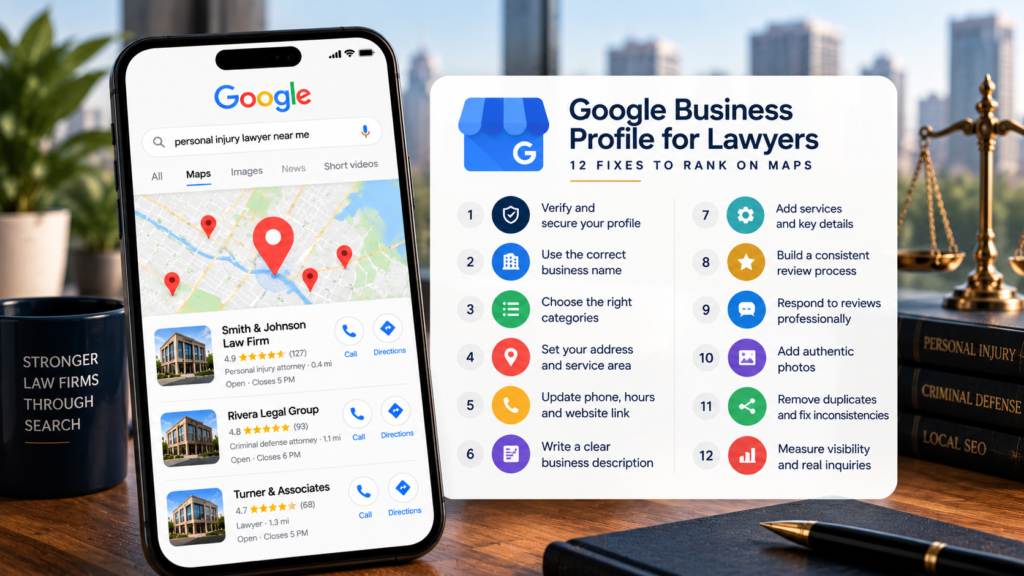
- Business Profile: Google says Business Profiles can help businesses appear in AI responses. Follow our guide to Google Business Profile for lawyers and keep your hours, categories and links current.
- Real recognition: pursue bar association speaking, legal publications and local press your lawyers have earned. Don't buy links or manufacture mentions.
How to monitor your firm's visibility in AI Overviews
Use three sources, because no single report shows the whole path from an AI Overview to a new client.
1. Search Console's Performance report
AI Overview and AI Mode clicks and impressions are counted within overall web search data. This report has clicks and queries, but it doesn't separate AI traffic. Google's John Mueller said in September 2026 that every link in an AI Overview takes the position of the whole block, so position won't tell you where you sit inside it.
2. The Generative AI performance report
Google introduced this Search Console report in June 2026 and has rolled it out gradually, so your property may not have it yet. As of Nov. 3, 2026, published reviews describe an impressions-only report that groups AI Overviews and AI Mode together, with breakdowns by page, country, device and date. They report no clicks, queries or position. It can show which pages surface in AI features, not which questions triggered them or whether anyone called.
3. A manual log of priority searches
Choose 20 to 30 searches that match work you want, including questions and service-and-city searches. Check them each month from the same location and device, and repeat each one, because results vary by query, place and time.
| Date | Search | Overview shown? | Firm cited? | Page cited | Other sources | Accurate? |
|---|---|---|---|---|---|---|
| Nov. 3 | When should a business hire an employment lawyer? | Yes | No | None | Bar association, directory | N/A |
| Nov. 3 | What does a commercial lawyer do? | Yes | Yes | Commercial contracts page | Legal guide | Yes |
Connect visibility to new clients
A citation is a visibility measure, not a business result. Many people read an answer and then search your name or call, so record how each inquiry found you at intake. Say a citation "contributed to" a new client only when your records support it.
| Metric | What it tells you | Source |
|---|---|---|
| AI impressions | Which pages surface in AI features | Generative AI report |
| AI Overview appearances and citations | Whether priority searches cite your pages | Manual log |
| Organic clicks | Whether search brings people to your site | Performance report |
| Qualified inquiries | Whether the right people contact you | Intake records |
| Consultations | Whether inquiries move forward | Intake records or calendar |
| New clients and cost per new client | Whether the work pays for itself | Firm records |
Common AI Overview mistakes law firms should avoid
- Paying for guaranteed citations. No one controls what Google cites.
- Publishing generic AI articles in volume. They add little and can run into Google's scaled content policy.
- Repeating keywords. Google's AI systems understand synonyms, so stuffing helps nobody.
- Creating a page for every variation. Near-identical pages dilute the site and raise spam risk.
- Adding markup that doesn't match the page. Structured data should describe visible content.
- Buying links or mentions. It risks your site and your firm's reputation.
- Skipping attorney review. An inaccurate answer can mislead readers and sits under your firm's name.
- Ignoring technical SEO. A page Google can't index can't be a supporting link.
- Measuring only citations. Visibility without inquiries doesn't help the firm.
- Treating a citation as permanent. Answers change, so a citation can't be held like an asset.
A practical AI search action plan for law firms
Work in this order unless your audit shows a more urgent problem. The early steps cost little, and they tell you whether the later ones are worth funding.
- Audit technical SEO, indexing and your Search generative AI setting.
- Record current inquiries, consultations and new clients by source.
- Build your log of priority searches.
- Improve the service pages tied to the work you want.
- Close the most useful content gaps, starting with questions from intake.
- Add authors, attorney review and stronger biographies.
- Connect related pages with internal links.
- Review structured data and business details for accuracy.
- Review results monthly and adjust.
Our SEO and GEO process for law firms shows how we run this work and what we won't promise. GEO, or generative engine optimization, is a common label for this kind of work. For Google, it's still SEO.
Frequently asked questions
What are Google AI Overviews?
They are AI-generated summaries in Google's results that include links to supporting websites. They appear only for some searches.
How can law firms appear in Google AI Overviews?
Make sure priority pages are indexed and eligible for snippets, keep your site included in Search generative AI features and publish useful legal content. That gives you a chance, not a guarantee.
How do you get cited in Google AI Overviews?
Google doesn't publish a citation formula. The best-supported approach is original, accurate and accessible content that answers a real question better than a generic summary does.
Do AI Overviews replace traditional Google rankings?
No. They appear alongside traditional results, though research suggests people click less when one is present.
Does SEO still matter for AI Overviews?
Yes. Google says SEO best practices remain relevant because these features are rooted in its core ranking and quality systems.
Does Google require special schema for AI Overviews?
No. Google says there's no special schema.org markup you need to add.
Does GEO help law firms appear in AI Overviews?
GEO is a label for work aimed at AI visibility. For Google Search, Google says that work is still SEO, so judge any GEO offer by what it actually does.
Can small law firms appear in AI Overviews?
Yes, they're eligible. Google sets no firm-size requirement, and a focused answer from a small firm can be useful. No firm of any size is assured a citation.
How can law firms track AI Overview citations?
Use a manual log for specific searches and Search Console for traffic and AI impressions. Search Console's AI report doesn't show which searches surfaced a page.
Does appearing in an AI Overview generate more clients?
It can contribute, but no reliable data shows how often. Compare citations, clicks, qualified inquiries and new clients in your own records.
Build a website worth citing
You can't make Google cite your firm. You can make your pages easy to find, publish what your lawyers actually know and measure what that work contributes. AI search for law firms will keep changing, and we don't know how far clicks will shift. Sound SEO and real legal knowledge are the safest things to build on today. Start this week by checking your Search generative AI setting and running your first 20 searches.
Is your firm's website ready for AI search?
Serptone Legal works only with US law firms. We connect technical SEO, useful legal content and AI search visibility, then report what the work contributes to qualified inquiries and new clients. We don't guarantee citations.
Sources checked Nov. 3, 2026. Google's features and reports change often, and third-party studies have the limits noted above. This article is marketing guidance for law firms, not legal advice.