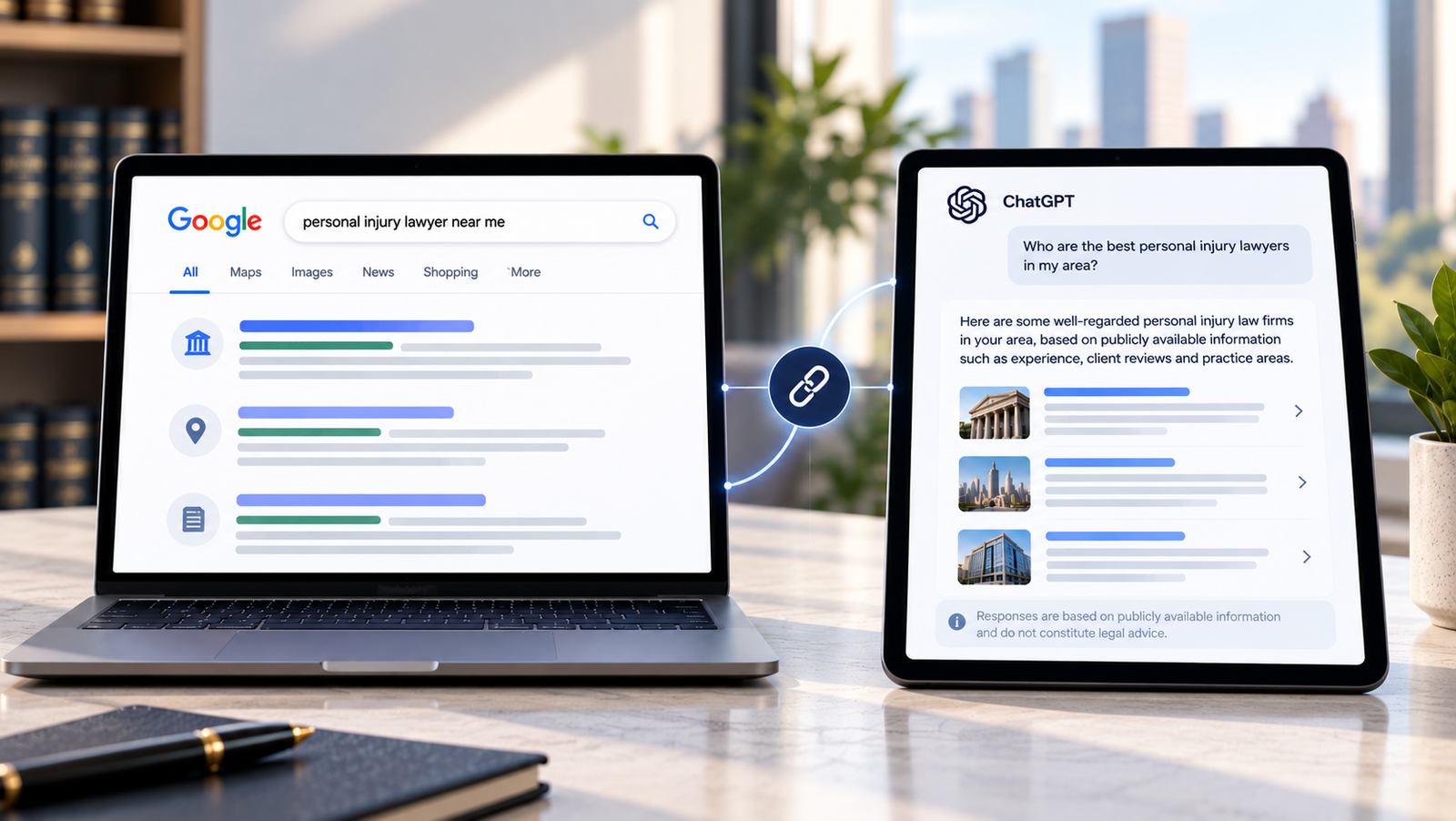
Law firms need both because they are two ways of being found that run on one foundation. Rankings still bring the clicks. AI-generated answers can now name or cite a firm before anyone clicks, and sometimes instead of a click.
So the useful question for a managing partner isn't "SEO or GEO?" It's this: what should the firm keep doing for Google, what deserves extra effort for AI answers and how will you know whether either is working? This guide answers all three. Where Google or OpenAI has published guidance, we point to it. Where nobody knows yet, we say so.
- Google says its AI features are rooted in its core ranking systems. SEO and GEO for law firms share most of the same work.
- What differs is how a firm appears (a link you click or a name in an answer) and how you measure it.
- No one can guarantee a firm will appear in an AI answer. That includes Google itself.
- Judge both by qualified inquiries and new clients. Rankings and mentions are steps along the way.
What SEO and GEO mean for a law firm
Search engine optimization (SEO) is the work that makes your website eligible, relevant and useful enough to appear in conventional search results, including the map results for local searches.
Generative engine optimization (GEO) is a newer label for work aimed at visibility inside AI-generated answers, such as Google's AI Overviews and AI Mode, ChatGPT and similar tools. Answer-engine optimization (AEO) is a close cousin. Practitioners use the two terms loosely and often interchangeably, so ask anyone who uses them what work they actually mean.
Google's own position is clear. Its guide to generative AI search says optimizing for those features is optimizing for search, and therefore "still SEO." It also says there are no extra technical requirements and no special markup needed to appear in AI Overviews or AI Mode (Google Search Central, updated July 2026).
That matters when you're buying. GEO is a useful name for a set of questions about AI answers. For Google, at least, it is not a separate technical discipline with its own rules. The foundation is the same work described in our website SEO for law firms service.
How conventional search and AI-generated answers differ
The foundation overlaps. The experience a prospective client has does not. Here is where the two part ways.
| Dimension | Conventional search | AI-generated answers |
|---|---|---|
| What the reader sees | A list of results and map listings. The reader compares and picks one. | A written answer that may name firms and may link to supporting pages. |
| Your website's role | The destination. A ranking earns a visit. | A possible source. A page may be cited, summarized or left out. |
| How often it appears | On nearly every search. | Only on some searches. Google shows AI Overviews only when it judges they add something, and often they don't appear. |
| What you control | Your pages, your site's technical health and your Google Business Profile. | The same inputs. The answer itself, and which sources it cites, belong to the platform. |
| How you measure it | Search Console impressions and clicks, then inquiries you can trace. | Partly in Search Console and analytics, partly by observation. Much of it isn't separately attributable. |
| How stable it is | Rankings move with updates and competition. | Answers can change by platform, wording, location and day. |
For more depth on each side, see how search engines rank law firms and how AI recommends law firms.
Where the work overlaps, and where each needs its own effort
Most of the budget belongs in the shared column. The two smaller columns are where a firm that only does one kind of work leaves gaps.
Work that serves both
- Pages Google can crawl and index
- Practice-area pages that answer real client questions
- Named lawyers behind the content
- Accurate firm, office and lawyer details
- Internal links to the pages that matter
- A fast, clear experience on phones
- An accurate Google Business Profile
Extra effort for search results
- Tracking priority searches by page and location
- Map results for service-and-city searches
- Titles and descriptions that earn the click
- Links from relevant sites, earned honestly
Extra effort for AI answers
- A fixed set of prompts checked on a schedule
- Checking that answers describe the firm accurately
- Letting each platform's search crawler reach your site
- Covering the follow-up questions clients ask, on existing pages
Why rankings still matter
Google's AI features don't work apart from its search results. According to Google, AI Overviews and AI Mode use its core ranking systems to retrieve pages from the search index, then build an answer from those pages. To be eligible as a supporting link, a page must be indexed and eligible to appear in search with a snippet.
The practical reading: a page Google can't find, doesn't index or doesn't trust is unlikely to be cited in its AI answers either. Strong rankings don't guarantee a citation. Weak foundations make one improbable.
There is a second reason. Google shows AI Overviews only on some searches. Many searches still return a classic page of results, and for local, consumer-facing practices the map results remain the first thing a searcher sees. If your firm serves clients near its offices, local SEO stays central. Google says Business Profile details can feed both AI responses and regular results.
Why AI-answer visibility deserves attention too
AI answers change when and how a firm is first encountered. Two illustrative journeys, not evidence of typical behavior:
- A consumer-facing example. Someone whose parent has just died asks an AI tool how probate works in their county. The answer explains the process and cites two firm websites. They read one of those pages, then call.
- A business-facing example. An HR director asks an AI tool whether a non-compete is enforceable for a remote employee. The answer summarizes the issue and links to an employment firm's guide. Months later, that firm is on the shortlist when the company needs counsel.
In both cases the firm was evaluated partly inside the answer, before any visit. That is the opportunity. It is also the risk: an answer can describe your firm inaccurately, list a practice you dropped or miss an office you opened. Watching what AI answers say about your firm is worth doing even if you never chase a citation.
Keep the value in proportion. A mention is not a website visit, a qualified inquiry or a signed case. Its worth depends on whether the answer is accurate, relevant to your actual practice and in front of the right reader.
For the deeper tactics, see our guide on getting a law firm recommended by ChatGPT and our explainer on how attorneys become citations in AI summaries.
What law firms should do for both kinds of visibility
Five areas, in rough order of priority. The first four serve rankings and AI answers alike.
1. Make important pages easy to find
- Confirm your key practice-area pages are indexed in Google Search Console.
- Check that robots.txt, your host or your security settings aren't blocking search crawlers. For ChatGPT search, OpenAI says its search crawler, OAI-SearchBot, must not be blocked. Its training crawler, GPTBot, is a separate decision.
- Link to practice-area pages from your navigation and related pages, so neither people nor crawlers have to hunt for them.
- Fix technical problems before assuming the content is at fault.
2. Answer real questions clearly
- Build pages around the questions prospective clients actually ask. Your intake team hears them every day.
- Use descriptive headings and put the direct answer near the top of each section.
- Cover the natural follow-up questions on the same page. Google describes its AI features running related searches behind the scenes, so complete pages tend to serve them well.
- Don't publish a near-duplicate page for every phrasing of a question. Google warns that mass-producing pages to manipulate results can breach its spam policies.
3. Make the firm's identity and services unmistakable
- Keep firm name, offices, lawyers and practice areas identical across your site, Google Business Profile and the directories you control.
- Describe your practice areas and service areas as they are, not as you hope they will be.
- Put important information in text, not only in images or downloadable files.
4. Support claims with evidence
- Name the lawyer who wrote or reviewed each legal page, with a short biography.
- Cite statutes, court rules and official sources for factual statements.
- Date your legal content and review it when the law changes.
- Say what depends on the facts of a case. Readers trust a page that admits limits.
Any page that describes your services or results may be covered by your state's lawyer advertising rules. Those rules vary by state and change, so check with your state bar or ethics counsel before publishing.
5. Skip the unsupported shortcuts
Google's July 2026 guide lists several popular GEO tactics that its search features don't use or need:
- llms.txt and other "AI files." Google Search ignores them. They neither help nor harm your Google visibility.
- Chopping content into tiny chunks. Not required. Write for the reader.
- Special schema markup for AI. There is none. Structured data is still useful for regular search features.
- Manufactured mentions. Paying for or planting mentions of your firm is unlikely to help and can run into spam systems.
- Third-party "AI visibility scores" presented as Google data. Google says no outside tool has access to its internal ranking or AI systems.
These points describe Google Search. Other AI platforms work differently and publish less, so treat confident claims about them with care. To see how we put the five areas into practice, read our SEO and GEO process.
How to measure search rankings and AI visibility
Measure in three layers, and don't let the first two stand in for the third.
Layer 1: Conventional search
- Impressions and clicks for priority pages and searches in Google Search Console.
- Organic visits and engagement in your analytics.
- Comparisons over matching periods, such as Q3 2026 vs. Q3 2025.
Layer 2: AI visibility
- Google's AI features. Clicks from AI Overviews and AI Mode are counted inside Search Console's overall web search data, and Google now offers a generative AI performance report in Search Console.
- ChatGPT. OpenAI says ChatGPT adds
utm_source=chatgpt.comto links it sends, so those visits can be separated in Google Analytics. - Observed answers. Keep a log of a fixed set of prompts, checked on a schedule, so changes are real rather than anecdotal.
| Date | Platform | Prompt | Firm named? | Pages cited | Accurate? |
|---|---|---|---|---|---|
| Oct. 6 | Google AI Mode | How long does probate take in [county]? | No | None | n/a |
| Oct. 6 | ChatGPT | Employment lawyer for a non-compete dispute in [city] | Yes | Non-compete guide | Lists an old office |
An illustrative prompt log. Record the platform, exact wording, date, location and whether you were signed in, because each can change the answer.
A handful of manual checks is a sample, not a measurement system. Treat it as a way to spot patterns and errors, not as a score.
Layer 3: Business outcomes
- Qualified inquiries, using a definition the firm and agency agree in writing.
- Consultations booked.
- New clients, signed cases or new matters, counted from the firm's own records.
- Cost per new client, once cost and attribution data are reliable.
Rankings, citations and traffic are intermediate signals. They don't prove a return on their own. AI visibility in particular is often invisible in analytics: a reader who sees your firm named in an answer may search your name later or call directly. When numbers rise, the honest phrase is "contributed to," with other factors such as ad spend, referrals and seasonality named alongside.
Google says clicks from results pages that include AI Overviews tend to be higher quality, with visitors spending more time on the site. That is Google's observation across the web. Check it against your own intake data before relying on it.
If you aren't sure what your current setup can measure, a law firm SEO audit is a sensible first step.
Questions to ask your SEO agency about SEO and GEO
Use these with your current agency or any you are considering. Good answers are specific, sourced and honest about what's uncertain.
- 1What work are you doing that supports conventional search visibility?
- 2What additional AI-search work do you recommend, and what evidence supports it?
- 3Which searches and AI prompts matter for our practice areas, and how did you choose them?
- 4How do you separate what you observed in AI answers from what a tool estimated?
- 5Which official sources back your recommendations?
- 6What will you report monthly, and which numbers come straight from our own data?
- 7How will you connect search activity to qualified inquiries and new clients?
- 8What is still uncertain, and when will we review the evidence together?
An agency that promises a ranking or an AI recommendation has answered a question nobody can honestly answer. Google says the same: no tool or service can guarantee ranking success.
SEO and GEO work best as one strategy
Conventional search and AI answers are different ways of being found, built on the same foundation. The priority order follows from that. Build a technically sound site. Publish accurate, distinctive pages written or reviewed by your lawyers. Make important pages easy to reach. Then measure what you can, in clients rather than clicks.
Any GEO work beyond that foundation should have a clear purpose and evidence behind it. Before buying another service, it is worth knowing what your current one already covers.
Not sure whether your current SEO accounts for AI search?
In a 30-minute strategy call, we'll look at what your firm can measure today, where your search and AI visibility stand and which next steps the evidence supports. If your current setup already covers it, we'll say so.
Book a strategy callFrequently asked questions
Is SEO still worth it for law firms now that AI search exists?
Yes. Google's AI features retrieve pages through its core ranking systems, and many searches still show a classic results page. SEO is the foundation for both kinds of visibility.
What is the difference between SEO, GEO and AEO?
SEO covers visibility in search results. GEO and AEO are newer labels for visibility inside AI-generated answers. Google treats work on its AI features as part of SEO, with no separate requirements.
Does Google require special optimization for AI Overviews?
No. Google says there are no additional technical requirements, no special schema and no need for llms.txt files. A page must be indexed and eligible to appear in search with a snippet.
Can anyone guarantee ChatGPT or Google will recommend my firm?
No. AI answers vary by platform, wording, location and time, and the platform decides what to cite. An agency can commit to the work and to honest reporting, not to placement.
How can my firm see traffic from AI search?
Google Search Console includes AI Overviews and AI Mode in its web search data and offers a generative AI performance report. Visits from ChatGPT carry a chatgpt.com source tag in analytics. A dated prompt log covers what analytics can't see.
Sources
- Google Search Central: Optimizing your website for generative AI features on Google Search (updated July 10, 2026)
- Google Search Central: AI features and your website (updated Dec. 10, 2025)
- Google Search Central: Guidance on third-party SEO tools, services and advice (updated June 5, 2026)
- OpenAI: Publishers and developers FAQ (checked Oct. 22, 2026)
This article is general marketing information, not legal advice.