To get divorce clients online, build a search presence that helps people at each stage of their decision. That takes a clear divorce page, an accurate Google Business Profile, useful answers, credible lawyer biographies and intake that responds. Ranking for "divorce lawyer near me" reaches people only near the end.
Many people weigh a divorce privately before they call anyone. A firm that appears only when they are ready to hire has to win on the map and on reviews alone, with no earlier trust to draw on. This guide shows how to get divorce clients by meeting people sooner, how the pieces connect and how to tell whether the work contributes to signed cases. It is the same thinking behind our approach to divorce lawyer SEO.
The short version
- Plan for four search stages, from early questions to choosing whom to contact.
- Fix tracking and intake before you add content. More visibility can't help if inquiries go unanswered or unrecorded.
- Treat privacy as part of the website. A spouse may share the prospective client's phone, email or computer.
- Build for AI answers on the same foundation as SEO. Google says its AI features need no special optimization.
- Judge the work by qualified inquiries, consultations and signed cases against your own baseline.
How prospective divorce clients search for a lawyer
Divorce often starts as a private decision. In 2015, researchers on a Brigham Young University project reported that thoughts of divorce can stay with one spouse for years before that person tells anyone. In a smaller 2023 survey by one law firm, more than half of about 200 respondents said they wanted a divorce for a year or longer before starting the process.
Both studies are more than two years old, and they describe deciding, not searching. We found no reliable data on how long divorce clients search before they call, so treat the stages below as a working map, not a timeline.
The final shortlist does appear to be small. In a March 2026 survey of 1,068 US adults who had hired a lawyer, 54% researched two or three firms and 19% researched one. Google Search was how 36% first found the firm they contacted, against 33% for personal referrals and 9% for AI tools. The survey came from a review software company and covered all practice areas, so read it as a general signal for divorce. For a firm built on referrals, those figures make search a sensible second source of new clients.
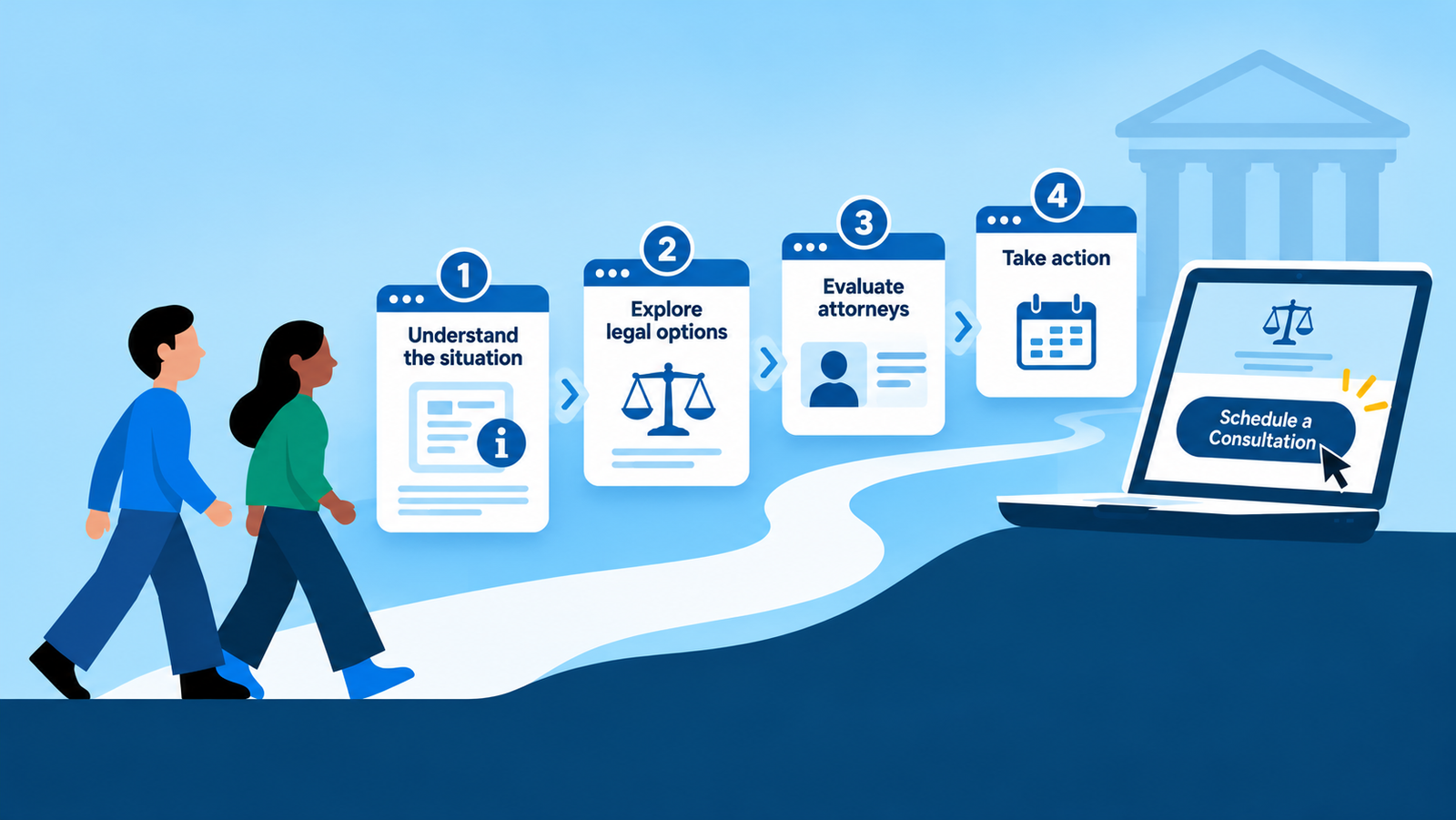
| Stage | What the person wants | Example searches | What should meet them |
|---|---|---|---|
| 1. Understand the situation | Plain information, with no pressure | What should I know before filing for divorce? | Attorney-reviewed articles on your state's process |
| 2. Explore legal options | To understand the paths available | Contested vs. uncontested divorce; mediation vs. litigation | Detailed guides and service explanations |
| 3. Evaluate attorneys | Confidence in a shortlist | Divorce lawyer in Denver; divorce attorney reviews | Divorce page, biographies, Google Business Profile and genuine reviews |
| 4. Take action | A clear, private next step | Divorce attorney consultation in Denver | Consultation details, an easy form and a person who responds |
Each stage has a different job. An article on contested divorce should answer the question and offer the next useful page. It shouldn't press a consultation on someone who may not have decided anything. A referred client may start at stage 3, and someone comparing lawyers may return to stage 2 with a new question.
Build a website that answers the questions people ask first
Your website is where the stages connect, so it should explain the work, the lawyers and the next step without forcing anyone to call to find out. Strong website SEO for law firms starts with that structure, because each page needs a clear purpose before it can rank.
Create a dedicated divorce page
- Services: the divorce work you actually do, such as contested divorce, mediation or high-asset matters.
- Coverage: the states and counties you serve, named specifically.
- People: the lawyers who handle this work, linked to their biographies.
- Process: what happens at a first consultation, how long it takes and whether it costs anything.
- Next step: a phone number and form that work well on a phone.
Make the next step private as well as clear
Most contact forms assume the person controls their phone, inbox and calendar. In divorce, a spouse may share them, so privacy belongs in the design of the form.
- Ask how to make contact. Let the person choose a safe number, email address and time before any confirmation goes out.
- Hold automated messages. Don't send text reminders or calendar invitations to a contact method nobody has confirmed as private.
- Ask for less at first. A short form reduces what is stored, and intake staff can gather details once the firm has checked for conflicts.
- Keep inquiry details out of marketing tools. Don't send form content to analytics or ad platforms, and review whether ad tracking belongs on divorce pages at all. An ad that follows someone onto a shared device can reveal what they were reading.
- Word confidentiality carefully. ABA Model Rule 1.18 addresses duties to prospective clients, and state versions differ. Ask your state bar or ethics counsel to review the wording on your forms.
- Consider a safety notice. The National Domestic Violence Hotline warns that computer and phone use can be monitored. If your firm handles these matters, a brief notice and a quick way to leave the page may help.
Use local SEO to reach people searching nearby
Google says local results depend mainly on relevance, distance and prominence. You can't change where a searcher stands, so local SEO for law firms works on the other two: how clearly your firm matches the search and how well known it is.
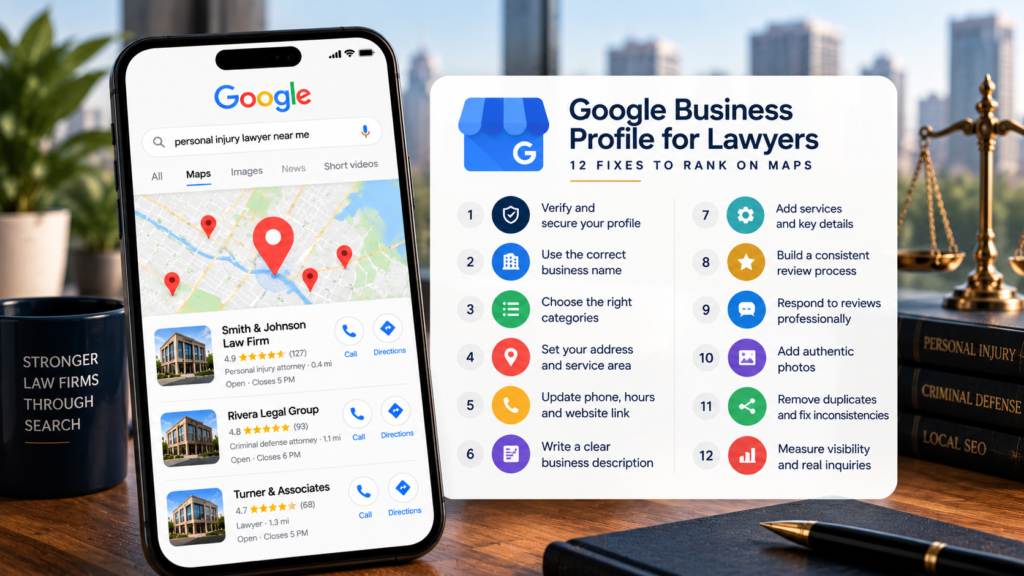
Keep your Google Business Profile accurate
A practical Google Business Profile for lawyers follows Google's guidelines, which matter here because a violation can cost you the profile.
- Name: use your firm's real-world name. Adding "divorce lawyer" or a city when that isn't your actual name can lead to suspension.
- Categories: choose as few as you need, and make them as specific as your main work allows.
- Address: use a real location. Google doesn't accept virtual offices, and co-working offices must meet its signage and staffing conditions.
- Lawyers: a firm with several public-facing lawyers can have a firm profile plus individual profiles. A solo lawyer at a branded firm should usually share one profile.
- Details: keep hours, services, photos and appointment links current, and use a phone number your firm controls.
Build location pages only where you have something to say
A location page should help someone in that place. Name the courts you appear in, the office they would visit and the lawyers who handle matters there. Then link to your main divorce page.
Test each page by swapping the county name. If it still reads true, it isn't ready. Google treats pages built to catch similar searches and funnel people elsewhere as doorway abuse, and it says those spam policies now apply to its AI responses too.
Develop a responsible review process
Reviews carry weight at stage 3. In the same 2026 survey, 63% read between three and 10 reviews before deciding, and respondents paid more attention to detailed client experiences and recency than to the star rating. Divorce makes reviews harder to earn, because many clients would rather keep the matter private. Respect that, and build a process that doesn't depend on pressure.
- Ask consistently. Google's Maps policy bars selectively asking only clients you expect to be happy.
- Offer nothing in return. Google prohibits incentives for a review or for changing one.
- Leave the content to the client. Don't request specific wording, and don't ask staff to collect a set number of reviews or reviews that name them.
- Never write, buy or reword a review.
- Take care with replies. ABA Formal Opinion 496 names client confidentiality as the main concern when a lawyer responds to a negative review. Rules vary by state, so check with your state bar or ethics counsel before you set a reply policy.
Publish content for the questions people ask
The strongest topics usually come from your own intake calls and consultations, because they show what people worried about before they reached you. Search Console can then show which questions already bring people to your site. Organize the articles by stage, and link each one to the service page a reader may want next.
| Topic group | Example article | Stage |
|---|---|---|
| Divorce basics | What to know before starting a divorce in your state | 1 |
| Divorce options | Contested vs. uncontested divorce | 2 |
| Children and parenting | Questions to ask about parenting arrangements | 2 |
| Financial questions | Financial issues to raise with a divorce attorney | 2 |
| Legal representation | When to hire a divorce attorney | 2 to 3 |
| Choosing a lawyer | What to look for when choosing a divorce attorney | 3 |
Keep legal explanations specific to the jurisdictions you serve, and have a lawyer who practices there review them. Show when each article was last reviewed, because divorce rules differ by state and change. If your practice also covers custody, support or adoption outside divorce, a broader plan for SEO for family law attorneys can sit around this one.
Establish credibility before the first consultation
Someone considering divorce is deciding whom to trust with a very personal matter. Give them facts they can check.
- Useful biographies: list each lawyer's role, bar admissions, practice areas, education and relevant publications or speaking.
- Named authors: show who wrote each legal article and which attorney reviewed it.
- Consistent details: match your firm name, address, phone number and lawyer information across your website, Google Business Profile and legal directories.
- Verifiable claims: describe experience in facts. Avoid "best divorce lawyer" and similar superlatives, and check your state's rules before using a word such as "specialist."
Make your firm easy for AI answers to understand
Generative engine optimization (GEO) means making your firm easy for AI tools to find, understand and cite. People are already using these tools at the research stages. Clio's 2026 Legal Trends Report found that 46% of consumers would consult AI before contacting a lawyer. That is an intention across all legal matters, so it doesn't tell us how many divorce clients will hire a firm through AI.
For Google, this work is SEO. Its documentation says AI Overviews and AI Mode have no additional requirements, and its generative AI guide stresses original content. Google also says Business Profiles can help a firm appear in AI responses. Our recommendations follow from that guidance, but other AI tools use their own systems, and nobody can guarantee a citation.
- Keep important pages accessible. They need to be crawlable, indexed and written in plain text.
- Publish what only your firm can say. Original answers from practicing lawyers give an AI tool more to work with than a rewrite of common advice.
- Keep facts consistent. Your practice areas, locations and lawyers should match wherever they appear.
- Check your firm's description. Ask major AI tools about your firm each month and record anything wrong, such as an old office or a practice area you don't offer.
- Skip the shortcuts. Google says you don't need AI text files or special markup. FAQ rich results have also stopped appearing in Google Search, so FAQ markup is not a reason to add FAQs.
We cover this further in how AI tools recommend law firms and how attorneys become cited in AI-generated summaries.
Turn website inquiries into consultations
Search can bring a person to your door, but intake decides what happens next. In Clio's 2024 secret-shopper test of 500 firms, 40% of firms answered the phone, down from 56% in 2019. The result is now two years old, but it remains a clear reason to test your own line. In the 2026 hiring survey cited earlier, 52% named slow or no response as a reason not to contact a firm, 72% expected a reply within the same business day and 60% made first contact by phone.
Those are general figures across practice areas. Set a standard your firm can keep, then put these basics in place:
- Make one named person responsible for every new inquiry, including those that arrive after hours.
- Run a conflict check early, since the other spouse may already have contacted the firm.
- Review missed calls and unanswered forms every week.
- Use a consistent follow-up that respects the contact preference the person gave you.
- Record the source of each inquiry at intake.
- Agree what counts as a qualified inquiry, so a number means the same thing to everyone.
- Connect each consultation to whether the person became a signed case.
Train for tone as well as speed. The person calling may be saying these words aloud for the first time, and a calm first conversation is part of how your firm earns the case. SEO can't make up for an intake process that regularly misses people.
Measure whether the strategy produces new divorce clients
Rankings are a means. Report from the top of the path to the bottom, and compare each number with your own baseline, not an industry average.
| Measure | What it tells you | Where to find it |
|---|---|---|
| Impressions and clicks | Whether people see and visit your pages | Google Search Console |
| Local visibility | Whether you appear for priority searches across your service area | Business Profile data or a rank tracker |
| Qualified inquiries | Whether appropriate people are contacting you | Intake records |
| Consultations booked | Whether inquiries move forward | Intake records or calendar |
| Signed cases | Whether search contributes to new clients | Case management records |
| Cost per signed case | Whether the economics work | Marketing cost divided by signed cases |
Search Console counts AI Overviews and AI Mode in your overall search traffic, and its Generative AI performance report shows how your content appears in those features. Be careful with cause and effect too. A rise can reflect SEO, ads, referrals or the season, so say search "contributed to" a result unless you can isolate it.
Estimate your break-even point
Use your own numbers to see how many extra signed cases a month would cover an SEO budget. The starting figures are illustrative, not a benchmark or a forecast.
Break-even: 3 signed cases a month
Qualified inquiries needed: 15 a month
If your market can't supply that many qualified inquiries, or the break-even number is high, narrow the scope before you spend more. This is a planning aid, not a promise of results.
How to build a practical online client acquisition plan
The order below puts measurement and intake ahead of new content, so you can see what each later step contributes. Your market, resources and starting point may change it.
- Audit what you have. Start with a law firm SEO audit, and confirm you control your domain, hosting, analytics and Google Business Profile.
- Set your baseline. Record current inquiries, consultations, signed cases and costs by source.
- Fix intake and privacy. Make sure every inquiry reaches a person and contact preferences are respected.
- Strengthen the divorce page. Make it the clearest page on your site for this work.
- Correct your Google Business Profile. Fix accuracy problems, then maintain the profile.
- Improve biographies and authorship. Give readers and search engines facts they can verify.
- Publish by stage. Begin with the questions you hear most often.
- Review monthly and adjust. Put effort where qualified inquiries and signed cases are moving.
You can see how we sequence similar work in our SEO and GEO process for law firms.
Frequently asked questions
How do divorce lawyers get more clients?
Most firms combine referrals with search visibility, useful content, a strong local presence, genuine reviews and responsive intake. Which of these matters most depends on your market and where inquiries currently stall.
How can I get divorce clients online?
Start with a clear divorce page, an accurate Google Business Profile and intake that responds. Then publish attorney-reviewed answers to the questions people ask before they choose a lawyer.
Does SEO work for divorce lawyers?
It can, when people in your market search for this help, your budget can compete and your case economics work. It tends to disappoint when intake misses inquiries or the firm has no capacity for more cases.
How can a divorce lawyer rank higher on Google?
Make your site easy to crawl, publish strong divorce and location pages, keep your business details accurate and earn genuine reviews and links. No one can honestly guarantee a position.
Is Google Business Profile important for divorce lawyers?
Yes, for firms that serve clients locally. It gives people your location, hours, reviews and contact details, and it helps Google understand when to show your firm in local results.
What should a divorce lawyer's website include?
Include a dedicated divorce page, lawyer biographies, attorney-reviewed answers, clear consultation details and a mobile-friendly form that lets people choose how to be contacted.
How long does SEO take to generate divorce clients?
Timelines vary. Our general forecast, not a promise: technical and local fixes can show within weeks, while competitive organic growth typically takes three to 12 months. That depends on your market, your site and your starting authority. Signed cases usually follow visibility, so they can take longer.
Can AI tools recommend divorce lawyers?
Yes, they can name firms, but results vary and no firm can control them. Accurate information, original content and a strong reputation across the web can make your firm easier to find and verify.
How should a divorce law firm measure SEO results?
Track qualified inquiries, consultations, signed cases and cost per signed case against your own baseline. Use rankings and traffic as supporting measures.
Build your search strategy around the whole decision
Getting divorce clients online takes more than appearing for "divorce lawyer near me." It takes a connected presence that helps people find useful information, discover your firm locally, check your credibility and contact you privately when they are ready. Start with the part closest to new clients: test your intake this week, then record what happens to the next 20 inquiries.
Want a clearer view of your firm's divorce search presence?
Serptone Legal works only with US law firms. See how we connect search visibility to qualified inquiries and new clients, or ask us to review where your firm stands today.
Sources checked Nov. 2, 2026. Survey figures come from third parties and cover all legal matters unless stated. This article is marketing guidance for law firms, not legal advice. Advertising, confidentiality and client-communication rules vary by state and change over time, so check with your state bar or ethics counsel.