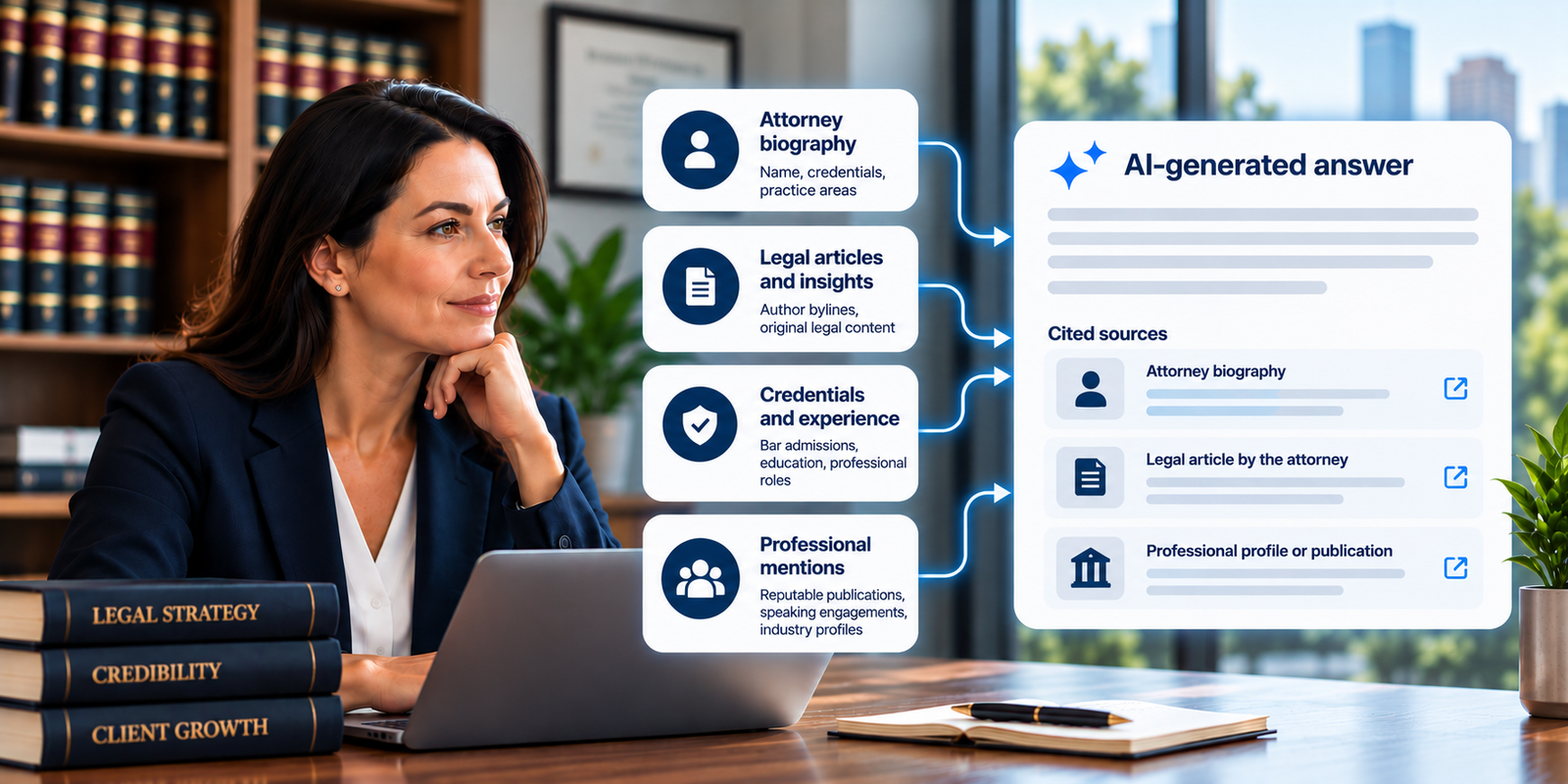
Lawyers get cited by AI when an AI tool finds a page that answers the question and can tell who stands behind it. You cannot choose which sources an AI answer uses. You can make each attorney easy to identify and check:
- An accurate, current biography for every attorney
- A named author, and a named reviewer where one exists, on every legal article
- Credentials a reader can confirm at the source
- Outside profiles that agree with your website
None of this guarantees a citation. It is the part of the work your firm controls, and it makes your site more useful to prospective clients whether or not an AI tool ever quotes it.
This guide is about one piece of AI search: the attorneys behind your content. For the wider picture, see how AI recommends law firms and our seven-step guide to getting your law firm recommended by ChatGPT.
By the end, you will have a 30-minute audit you can run on one attorney and one practice page. You will also know which parts of it rest on published guidance and which rest on reasonable judgment.
What it means for an attorney to be cited by AI
"Cited" gets used loosely, and the loose use hides real differences. An AI answer can involve your attorney in four distinct ways, and each one proves something different.
| What you see | What it shows | What it does not prove |
|---|---|---|
| The attorney is named in the answer | The tool connected the lawyer to the topic | That anyone clicked, or that the description was accurate |
| A page on the firm's site is linked | The tool used your page as a source | That the linked page was the attorney's own work |
| An article the attorney wrote or reviewed is linked | The tool drew on that attorney's content | That the byline played any part in the choice |
| The firm is recommended with no source shown | The firm was named | Where the information came from |
How sources are chosen also differs by product. Google says its AI Overviews and AI Mode use its core search ranking systems to pull pages from its index. A page must be indexed and eligible to show a snippet, and there are no extra requirements beyond that. OpenAI says ChatGPT search ranks results on several factors meant to surface relevant, reliable information, and that placement is not guaranteed. It also warns users that citations can be incomplete, outdated or wrong.
Neither company publishes a list of signals that names attorney biographies or bylines. Anyone who calls a bio field an "AI ranking factor" is guessing.
What is documented and what is a reasonable bet
Lawyers are trained to separate what a source says from what someone infers from it. This table applies that discipline to the advice in this guide.
| Practice | What official guidance says | What remains unknown |
|---|---|---|
| Bylines that link to a biography | Google strongly encourages accurate authorship information, with bylines that lead to background on the author | Whether any AI tool weighs a byline when it selects a source |
| Content written or reviewed by an expert | Google's self-assessment asks whether content is written or reviewed by someone who demonstrably knows the topic | How each product judges expertise for a given question |
| Original, first-hand content | Google's AI search guide says unique, non-commodity content will likely matter more over time than any of its other suggestions | How originality is weighed against other factors |
| Author structured data | Google recommends linking the author to a bio page in its article markup, and says no special markup is needed for its AI features | Whether markup affects any AI citation |
| Mentions on other sites | Google says chasing inauthentic mentions is not as helpful as it might seem | How much genuine mentions count, and on which products |
| Crawl access | Google requires pages to be indexed; OpenAI asks sites to allow its search crawler, OAI-SearchBot | Nothing; this is a documented prerequisite |
One more point from Google matters for law firms. Google says experience, expertise, authoritativeness and trust (often shortened to E-E-A-T) is not a specific ranking factor. It also says its systems give more weight to signs of that quality on topics that can significantly affect a person's finances, safety or well-being. Many legal questions fall into that territory.
Our working view is that making an attorney easy to verify serves readers first. It also fits what these systems say they look for: relevant, reliable information from sources that show who is behind them. That is a reasonable bet about AI tools, not a proven formula. It is a sound standard for legal content either way.
The verification chain: five links a reader can follow
The generic advice is "add an author bio." The more useful idea is a chain that a skeptical reader can follow from the answer back to the lawyer.
- A named attorneyThe same name everywhere it appears, tied to one person.
- A current biographyOne page that states the attorney's role, practice and jurisdictions accurately.
- Credentials checkable at the sourceAdmissions, certifications and honors a reader can confirm with the body that granted them.
- Content the attorney actually wrote or reviewedLegal articles and practice pages that name them honestly and cite primary law.
- Outside profiles that agreeBar records, directories and publications that match what your site says.
When every link holds, a reader can confirm who the attorney is in a few clicks. When one breaks, the reader has to take your word for it. Common breaks include a byline that leads nowhere and a bio that still lists a practice the lawyer left two years ago. The next six sections work through each link.
1. Make the attorney's identity unmistakable
Start with the basics, because errors here undermine everything built on top of them.
- Use one name consistently. If the state bar lists "J. Robert Hale" and your site says "Bob Hale," a reader may not be sure they are the same person. Pick the professional name and use it on your site, profiles and bylines.
- Give each attorney one bio page. Keep it at a stable web address, in readable page text rather than a PDF or an image.
- State the current role and office. Partner, associate or of counsel, and where they work.
- List practice areas and jurisdictions that match the actual work. Not every service the firm offers.
- Handle departures. When a lawyer leaves, update their articles' bylines and reviewer credits. Do not leave content attributed to someone who no longer stands behind it.
2. Write a biography that proves relevant experience
Most attorney bios are written to impress. A useful one is written to be checked. Compare two versions for the same hypothetical lawyer.
[Name] is a dedicated and aggressive advocate with years of experience fighting for clients. Recognized as one of the top attorneys in the region, [Name] is passionate about delivering results.
[Name] is a partner at [Firm] who handles employment disputes for small and midsize businesses.
- Admitted: [State], [year]; [federal district court]
- Focus: wage-and-hour claims, restrictive covenants, workplace investigations
- Education: J.D., [law school], [year]
- Writes and reviews: [links to articles]
- Speaking: [event, organizer, year]
- Bio last reviewed: [date]
A hypothetical example. Bracketed details stand in for facts each firm supplies.
The second version is not longer for the sake of it. Every line in it can be checked, and the first version has no line that can. A strong bio covers:
- Current role and jurisdictional admissions
- The practice areas the attorney actually handles
- Relevant experience, described precisely
- Education and credentials that can be confirmed
- Publications, talks and professional roles with names and dates
- Links to the legal content the attorney wrote or reviewed
- A date showing when the bio was last checked
Leave out what a reader cannot verify. Superlatives such as "top" or "leading" need a named, dated source or should go. Words such as "expert" and "specialist" carry extra risk: certification claims are regulated in many states, and ABA Model Rule 7.2 addresses them. Check with your state bar or ethics counsel before using either word. The same applies to listing past case results.
3. Name who wrote and who reviewed each legal article
Google suggests site owners ask "Who created this?" about their content. A visible byline, linked to the author's biography, answers that question for a reader in one click. On legal content, it also tells the reader whether a lawyer stands behind the explanation.
Many firms produce articles with help from staff or an agency. That is fine, as long as the byline is honest about who did what. Separate three roles:
- Author: the person who wrote the substance
- Editorial support: drafting, structure or search research
- Legal review: an attorney who checked the legal content for accuracy
An example of the format, not a real article.
Three rules keep a byline trustworthy:
- Never name an attorney as author or reviewer of work they did not write or review. Google describes false credentials and made-up creator profiles as deception.
- Change the review date only when someone actually reviews the article. Google also warns against updating dates to make pages look fresh.
- Set review triggers. Re-review when a statute, court rule or agency guidance the article relies on changes.
If your site uses article structured data, Google's guidance is to put only the person's name in the author name field and to point the author's URL at their bio page. Keep the markup consistent with the visible byline. Google is clear that no special markup is needed for its AI features, so treat markup as a way to restate what the page already shows, not as a citation lever.
4. Show credentials and back legal claims with primary sources
A credential is only as useful as a reader's ability to confirm it. Different kinds of claims need different kinds of proof.
| Type of claim | Example | Where a reader verifies it |
|---|---|---|
| Bar admission | Admitted in [State], [year] | The state bar or court's attorney lookup |
| Certification | Certified in [area] by [body] | The certifying body's directory; confirm your state recognizes it |
| Membership | Member, [association] [section] | The association's directory; membership is not an endorsement |
| Award or listing | [Award], [awarding body], [year] | The awarding body's site, ideally with its selection method |
| Experience | Handles wage-and-hour claims | Content and matters the attorney can substantiate |
Keep these categories distinct on the page. A membership described as an honor, or an award shown without its source and year, invites exactly the doubt you are trying to remove.
The same standard applies to the legal content itself. When an article states what the law requires, link to the statute, court rule or official agency page it relies on. Name the jurisdiction, and note that the answer can change with the facts. A reader, or anyone checking your work, can then confirm the claim in seconds.
5. Build a legitimate footprint beyond your website
People often check a lawyer somewhere other than the firm's site. Accurate outside information helps them confirm what your site says. Useful places include:
- The official bar or court profile
- Established professional associations and their sections
- Legal publications, bar journals and continuing legal education programs
- Conference speaker pages
- Genuine interviews or commentary in news coverage
- Accurate business profiles, such as the firm's Google Business Profile
Relevance and accuracy matter more than volume. Ten outdated directory listings help no one, and one that conflicts with your site creates doubt. Google's own guidance on its AI search says chasing inauthentic mentions is not as helpful as it might seem.
Avoid anything manufactured: invented credentials, fake reviews, paid listings presented as earned honors and profiles created only to add mentions. Each one puts the firm's reputation at risk, and none of it makes an attorney easier to verify.
6. Connect each biography to the work it supports
The final link joins the attorney to the firm's practice. A reader on a practice page should be able to see who handles that work and read about them. A reader on a bio should be able to reach that lawyer's articles and practice pages.
- Link from each practice page to the attorneys who handle that work.
- Link from each article to the author's and reviewer's bios.
- Link from each bio back to the attorney's practice pages and articles.
- Use descriptive link text, such as "read [Name]'s guide to non-compete agreements," rather than "click here."
- Check for broken links, outdated pages and contradictions between pages.
Do not imply experience the firm cannot substantiate. Linking every attorney to every practice page blurs the very connection you are trying to show. Internal links and readable page text are also among the SEO fundamentals Google lists for its AI features, which is why this work overlaps with website SEO for law firms.
Run a 30-minute attorney credibility audit
Pick one attorney and the practice page that matters most to the firm. Work through three passes of about ten minutes each, and note every "no."
Pass 1: Identity and qualifications About 10 minutes
- Is the attorney's name the same on the bio, the bylines and the bar record?
- Is the bio current: role, office and practice areas?
- Are bar admissions and jurisdictions stated correctly?
- Can every credential on the bio be confirmed with the body that granted it?
Pass 2: Authorship and sources About 10 minutes
- Does each important legal article name its author, linked to a bio?
- Is any reviewer named accurately, with a review that actually happened?
- Do legal claims link to primary sources and name the jurisdiction?
- Are publication and review dates accurate and suited to the subject?
Pass 3: Connections and consistency About 10 minutes
- Does the practice page link to the right attorney, and does the bio link back?
- Do the bar profile and main directory listings match the site?
- Is the important information in readable text, not only in images or PDFs?
- Can you reach the bio from the home page through normal navigation?
Then fix what you found in this order:
- Correct factual errors. A wrong admission date or a stale title undermines everything else.
- Clarify authorship and credentials. Honest bylines and checkable qualifications.
- Strengthen the links between bios, articles and practice pages.
- Check technical access. Confirm the key pages are indexed and that search crawlers are not blocked.
The items do not carry equal weight on every AI platform, and no one outside those companies knows the weights. The order above follows a simpler logic: accuracy first, because an error is a problem for every reader. For a wider review of the whole site, see what a law firm SEO audit should cover.
How to test whether AI tools cite your attorneys
One screenshot proves very little. AI answers vary from run to run, by product and by the searcher's location. A useful test is repeatable.
- Write a fixed set of realistic questions for your practice areas and cities.
- Record the exact wording, the product, the date and the location you tested from.
- Run each question more than once, and repeat the full set at planned intervals.
- Log what happened, using fields like these.
| Field | What to record |
|---|---|
| Attorney named | Yes, no or unclear |
| Source linked | The exact URL, if any |
| Attorney's own content | Whether the linked page is something this attorney wrote or reviewed |
| Description accurate | Whether the answer states the attorney's role, practice and location correctly |
| Next action | One specific issue to investigate |
When an answer describes an attorney wrongly, you cannot edit the answer. Find the page or profile the error most likely came from and correct it there.
Keep each stage separate when you report results. A mention is not a citation, a citation is not a website visit, and a visit is not a qualified inquiry or a new client. Google reports traffic from its AI features inside the Search Console Performance report and also offers a Generative AI performance report. Our guide to testing AI visibility and connecting it to new matters covers referral tracking and intake in detail.
"[Attorney] was named in 3 of 24 test runs in November, and her article was the linked source in 2 of those 3 (source: prompt log)."
"Your attorneys are now trusted by AI."
The figures are invented to show the format. They are not client results.
What attorney credibility work cannot guarantee
A skeptical owner will ask these questions. Here are the honest answers.
- Will an updated bio get an attorney cited? Not necessarily. It removes one reason a reader or system might hesitate.
- Will structured data get an attorney cited? No. Google says no special markup is needed for its AI features.
- Do more outside mentions always help? No. Accurate, relevant ones help readers. Manufactured ones carry risk.
- Can an agency guarantee an AI citation or recommendation? No. OpenAI states that placement is not guaranteed, and Google says the same about indexing and serving.
- Is this separate from SEO? Mostly not. Google describes optimizing for its AI search as still SEO, and most of this work also improves your site for people.
Your firm controls the accuracy of its information, the honesty of its bylines and the way it measures results. It does not control which source a platform picks for a particular answer. Good work focuses on the first set and is candid about the second.
Frequently asked questions
How do lawyers get cited by AI?
An AI tool has to find a relevant page and use it as a source. Firms can't control that choice, but they can publish useful legal content that names its author, link that author to an accurate bio, show credentials a reader can confirm and keep outside profiles consistent with the site. That makes the attorney easy to verify, which is the part a firm controls.
Does every legal article need a named attorney author?
Not every page, but any article that explains the law should show who wrote it and, where it applies, which attorney reviewed it. Google encourages bylines wherever readers would expect one, and legal readers usually do.
What should an attorney biography include?
Current role, bar admissions and jurisdictions, the practice areas the lawyer actually handles, education, verifiable publications or talks, links to their articles and the date the bio was last reviewed. Specific, checkable facts matter more than length.
Do attorney credentials help AI search visibility?
No AI company publishes that a credential raises the chance of a citation. Credentials do help readers trust content, and the systems say they aim to surface relevant, reliable information. State them accurately and make them easy to confirm.
Do external mentions guarantee that an AI tool will cite a lawyer?
No. Genuine coverage in bar publications, associations or the news helps readers confirm who a lawyer is. Google says chasing inauthentic mentions is not as helpful as it might seem.
How can a law firm check whether AI tools cite its website?
Run a fixed set of realistic questions on each product, record the date and wording, repeat them over time and log whether the attorney is named and which page is linked. Then check analytics and intake records to see whether any of it leads to qualified inquiries.
How often should attorney bios and legal articles be reviewed?
Review bios whenever a role, admission or practice changes, and at least once a year. Review legal articles when the law, court rules or agency guidance they rely on changes, and record the review date only when a review actually happens.
Make your attorneys' expertise easy to verify
The firms best placed for AI search are not the ones chasing a formula. They are the ones whose attorneys can be checked: an accurate identity, honest authorship and review, credentials confirmable at the source, primary-law citations, outside profiles that agree and clear links between each lawyer and their work.
Improve what you can substantiate, measure what you can observe and treat any promised AI citation with the skepticism you would apply to a promised verdict.
See how AI tools describe your attorneys today
Serptone Legal does SEO for US law firms and no one else. Our free audit checks what the main AI tools say when asked about your practice areas in your city, and reviews the attorney bios, bylines and profiles behind those answers. It includes a 30-minute strategy call, is confidential and carries no obligation.
You will get a clear list of what to fix first. You will not get a promise that an AI tool will cite your firm. If you want help with the work itself, see our GEO and AI SEO for law firms.
Sources and further reading
- Google Search Central: AI features and your website. Requirements for AI Overviews and AI Mode, and how their traffic is reported. Last updated Dec. 10, 2025.
- Google Search Central: Optimizing your website for generative AI features. Non-commodity content, mentions, structured data and the Generative AI performance report. Last updated July 10, 2026.
- Google Search Central: Creating helpful, reliable, people-first content. Bylines, author information, E-E-A-T and deceptive authorship. Last updated Oct. 5, 2026.
- Google Search Central: Article structured data. Author markup best practices. Last updated Sept. 8, 2026.
- OpenAI: Searching the web with ChatGPT. Citations, ranking and eligibility for ChatGPT search. Checked October 2026.
- American Bar Association: Jurisdictional rules comparison charts. How each state has adopted the Model Rules on lawyer advertising. Checked October 2026.
This article provides general marketing information, not legal advice. Lawyer advertising rules vary by state and change over time. Firms should confirm their obligations on biographies, credentials, certifications and case results with their state bar or ethics counsel.