Immigration lawyer marketing works in two languages when each one gets its own useful page, an accurate local presence and a person who can respond in that language. Translating an English site word for word doesn't do that.
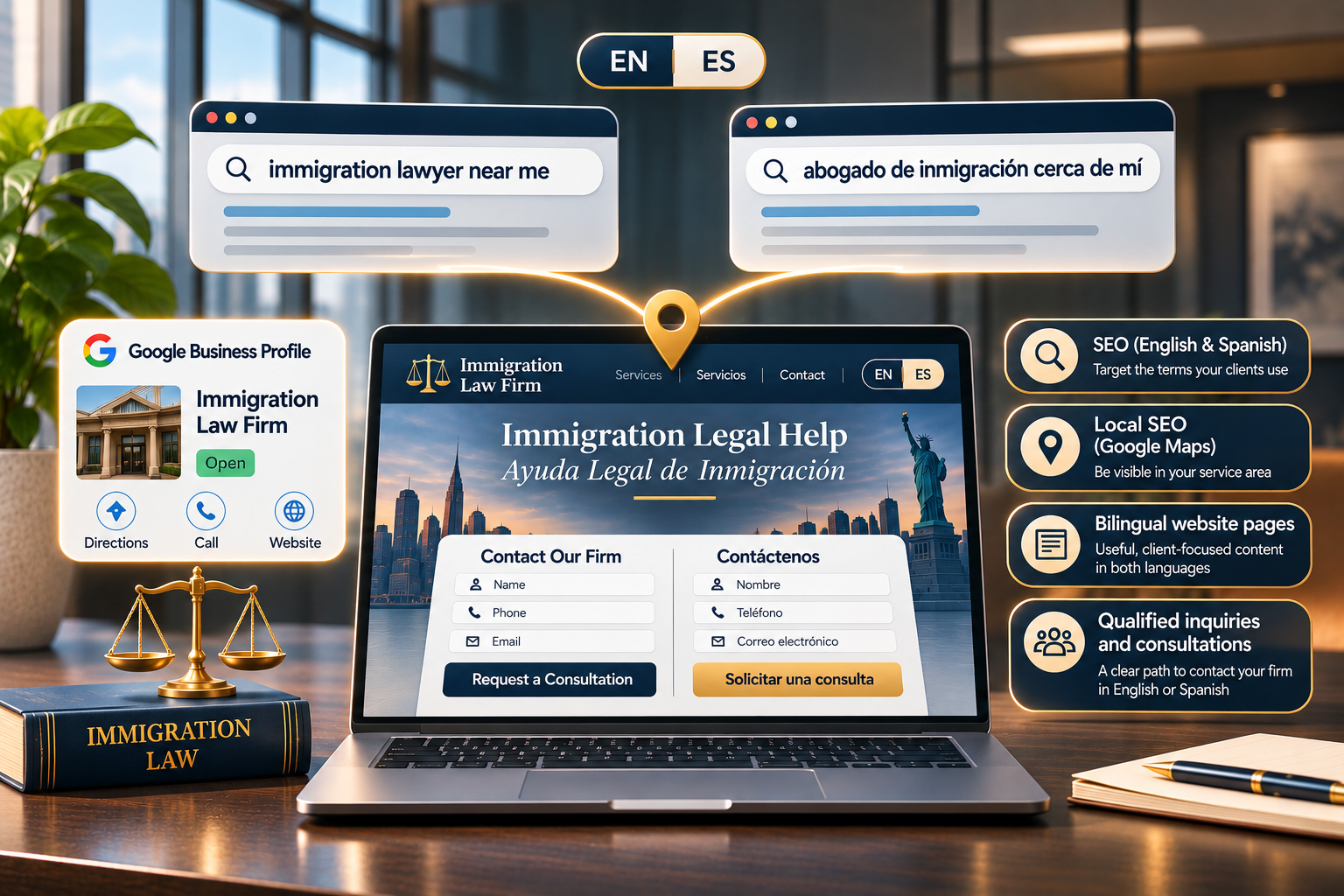
One person in your city searches "immigration lawyer near me." Another searches "abogado de inmigración cerca de mí." Both may need the same help, but a site built only in English may not answer the second person. This guide shows how to check whether Spanish search is worth pursuing in your market, then how to plan, publish and measure it. If you'd rather have that work done for you, start with our immigration attorney SEO service.
The short version
- Check your own market first. No published data shows how much Spanish search your firm is missing.
- Build pages only for services your firm can actually handle in Spanish.
- Give each language its own URL, and connect the pair with
hreflangtags. - State exactly who speaks Spanish. "Hablamos español" can mislead if the attorney doesn't.
- Judge the work by qualified inquiries, consultations and new matters in each language.
Why bilingual search matters for immigration law firms
About 44.9 million US residents spoke Spanish at home in 2024, based on Census Bureau data, and about 41% of them spoke English less than "very well." Language preference also shifts with time in the country. In a 2023 Pew survey of 5,078 Hispanic adults, 47% of immigrants preferred news in Spanish, 22% preferred English and 31% had no preference.
The Pew survey is now three years old, and neither figure measures legal search or says anything about your city. They do show why one person may search in Spanish, in English or in both. A son or daughter may search in English for a parent who will speak with you in Spanish, so don't treat the language of the search as the language of the client.
For your own market, use the Census Bureau's language spoken at home table and filter it to the counties you serve. Those estimates show who lives there, not who needs a lawyer, so treat them as a reason to look further.
Run a 30-minute Spanish search check
You may have heard that most immigration firms compete only in English. We know of no reliable data on that, and it will vary by city. Some markets may be wide open, while others may be crowded with Spanish pages and ads. Don't assume Spanish is easier to rank for. Check it yourself:
- List 10 searches: five in English and five in Spanish, covering your priority services and city.
- Run each from your office on a phone, and use a private browser window.
- Record the results in the table below.
- Repeat the check next month, because results change.
| Check | What the answer tells you |
|---|---|
| Does your firm appear in the map or the organic results? | Whether Google connects your firm to this search |
| Which page appears? | An English page here may mean you have no useful Spanish page |
| Are the first results written in Spanish? | Whether Spanish pages are competing here at all |
| Are those pages useful, or thin translations? | How high the bar is in your market |
| Who else appears? | Which firms, directories and ads you're up against |
Then look at your own records. If intake already hears from Spanish-speaking callers who found you online, that is stronger evidence than any keyword tool. If your firm can't serve people in Spanish, stop here and fix that first.
Start with the immigration services your firm actually handles
Language pages should follow your capacity, not your keyword list. For each practice area, ask whether you accept this work, serve the location, can communicate in Spanish, can handle more inquiries and have an attorney to review the page. If you run several practice areas, this is the same discipline behind organic growth across multiple practice areas.
| Practice area | English page | Spanish page | Who handles it in Spanish? | Decision |
|---|---|---|---|---|
| Family-based immigration | Strong | None | Attorney | Build first |
| Citizenship | Thin | None | Attorney | Improve English, then build Spanish |
| Deportation defense | Strong | Thin translation | Attorney, with urgent calls covered | Rewrite |
| Asylum | Strong | None | Interpreter only | Decide capacity before building |
| Work visas | Strong | None | Few Spanish inquiries | Hold |
This example is invented to show the method. It doesn't describe a real firm.
Research what people search for in English and Spanish
A translated keyword list misses how people describe their situation. Someone may use the legal term, the English term or a plain description of what happened. Spanish also varies by country and community, so one phrase won't fit everyone.
| Need | English search | Spanish searches to test |
|---|---|---|
| Finding a lawyer | Immigration lawyer near me | Abogado de inmigración cerca de mí; abogado migratorio |
| Permanent residence | Green card lawyer | Abogado para residencia permanente; abogado para green card |
| Citizenship | Citizenship lawyer | Abogado de ciudadanía |
| Removal proceedings | Deportation defense lawyer | Abogado de deportación; defensa contra la deportación |
| Asylum | Asylum lawyer | Abogado de asilo |
Have a Spanish-speaking legal professional review this list against the language your community uses. Then use three sources:
- Intake: ask reception which words callers use. This is often your most useful source, and no competitor can see it.
- Search Console: open the Performance report, add a query filter, choose "Custom (regex)" and try the pattern below. It shows the Spanish searches already bringing up your site.
- Keyword tools: check phrases by city and language, but treat volumes as estimates. Low figures don't prove nobody searches that way.
abogad|inmigraci|deportaci|residencia|ciudadan|asilo|notariSeparate urgent searches from early research as you sort the list. Someone searching about a family member's detention needs a different page from someone comparing paths to citizenship.
Build English and Spanish pages that deserve to rank
You usually don't need a second website. One domain with a Spanish section keeps your firm's details and authority in one place, and strong website SEO for law firms applies to both languages. The same ranking basics apply, and we know of no Google advantage for Spanish pages. See how search engines rank law firms for those basics.
Give each language version its own URL
Google recommends different URLs for each language, not cookies or browser settings on one address. A simple structure might be /immigration-lawyer/ and /es/abogado-de-inmigracion/. These are examples, not required formats.
Make the Spanish page genuinely useful
A page should cover the services you handle, the locations you serve, who the attorneys are, whether consultations happen in Spanish, what happens after someone makes contact and any limits on your services. Don't translate only the menu and buttons. Google warns that leaving main content in another language can create a bad experience.
Localize instead of translating word for word
Translation carries the words across. Localization asks how your community would actually say it and what they need to know. A machine draft can be a starting point, but it shouldn't be the final review. A qualified Spanish speaker should check the meaning, tone and legal terms, and a licensed attorney should review the legal content. Publishing many unreviewed translations can also run into Google's scaled content abuse policy, which applies however the pages are produced.
Connect the language versions technically
hreflang is a short tag that tells Google two pages are versions of each other. Google requires each version to list itself and every other version. If two pages don't point to each other, the tags are ignored. Put the same two lines on both pages:
<link rel="alternate" hreflang="en-US" href="https://www.example.com/immigration-lawyer/">
<link rel="alternate" hreflang="es-US" href="https://www.example.com/es/abogado-de-inmigracion/">- Language detection: Google reads the visible content and doesn't use the
langattribute, so keep each page mostly in one language. - Language switcher: use a visible, normal link to the matching page, not the home page.
- Redirects: don't send people to a language automatically. Google says this can stop users and search engines from reaching every version.
- Limits:
hreflanghelps Google show the right version. It doesn't guarantee indexing or rankings.
Hold Spanish claims to the same standard as English
A Spanish page is still lawyer advertising, and it may get less review inside the firm if the partners don't read Spanish. ABA Model Rule 7.1 addresses false or misleading communications, and state rules vary and change. Check the Spanish wording with your state bar or ethics counsel, not just the English draft.
Say exactly who speaks Spanish
"Hablamos español" sounds simple, but a reader may take it to mean the attorney does. State what's true for your firm. Have these drafts reviewed before you use them.
| Your situation | English | Spanish |
|---|---|---|
| An attorney is fluent | You can meet with your attorney in Spanish. | Puede reunirse con su abogado en español. |
| Staff speak Spanish, the attorney doesn't | Our staff speak Spanish. Attorney consultations use an interpreter. | Nuestro personal habla español. Las consultas con el abogado se realizan con intérprete. |
| Only first contact is in Spanish | You can contact us in Spanish. We'll explain which services we can provide in Spanish. | Puede comunicarse con nosotros en español. Le explicaremos qué servicios podemos ofrecer en español. |
Take care with "notario"
Here's a translation trap unique to this field. The Washington attorney general explained in 2014 that in Latin America a notario público has extensive legal training, while a US notary needs none. Connecticut's consumer protection agency states plainly that in the US, notarios are not lawyers. A literal translation can mislead, and states regulate this wording in different ways, so never describe your firm or staff this way.
The same confusion can make a useful page. An attorney-reviewed Spanish article on who can legally help with an immigration case serves readers and shows how to verify your lawyers. Keep it factual, not alarming.
Make your firm easy to verify
Fake lawyers have advertised as law firms on Facebook and TikTok, so a cautious reader has reason to check. Show each attorney's real name, bar admission, office address and phone number on the Spanish page, and link to the state bar's lawyer lookup. Avoid "los mejores abogados" and "especialista" unless your state's rules and the facts support them.
Build a local SEO strategy for both languages
Google says local results depend mainly on relevance, distance and prominence. Local SEO for law firms works on the first and third, and language can support relevance when your details are accurate.
Keep one accurate Google Business Profile
Follow our guide to Google Business Profile for lawyers, plus these points for bilingual firms:
- Name: keep your real-world firm name. Google's guidelines don't allow a name repeated in two languages, and added keywords can lead to suspension.
- Profiles: don't create a second profile for Spanish. Google allows one profile per business at a location, with separate rules for individual lawyers.
- Description: state your actual services and language capabilities in plain words.
- Link: send people to your most useful page, and make sure its language switcher works on a phone.
Google doesn't publish much on how a profile behaves across languages, so test it. Search in Spanish from your service area and see what shows.
Ask for reviews with extra care
Genuine reviews help people judge a firm, but immigration has a risk other practices don't. A 2025 New York State Bar ethics opinion warns that immigration matters can be reopened even after they appear closed, and that a review could expose a client. Check your state's guidance before you set a process. Let clients write in their own language, never suggest wording and don't offer anything in return.
Build local relevance beyond the profile
Create English and Spanish location pages only where you have an office, a real service area and something local to say. Keep your details consistent in directories. Community organizations, consulates and legal aid referral lists can lead to legitimate mentions when your lawyers do real work with them.
Make the intake process bilingual too
Picture a visitor on your Spanish deportation defense page. The page is clear, but the only form is in English and nothing says anyone can reply in Spanish. Your search is bilingual, but your intake isn't.
- Forms: offer them in Spanish, and ask which language the person prefers.
- Phones: say when someone can answer in Spanish. A voicemail greeting in both languages costs little.
- After hours: you don't need a 24-hour team. Say honestly when you'll respond, and plan for urgent matters.
- Next steps: explain what happens after a form is sent, and that asking for a consultation doesn't make someone a client.
- Privacy: don't ask for immigration status on a web form. Keep form details out of analytics and ad tools, and let people choose a safe way to be contacted. A family member may share the phone.
- Ownership: name who responds in Spanish, and who covers when that person is out.
Measure bilingual SEO by inquiries and new matters
The number of Spanish pages tells you nothing. Compare each measure with your own baseline, and name the period and data source.
| Measure | What it tells you | Source |
|---|---|---|
| Impressions and clicks by language page | Whether people see and visit each version | Search Console, filtered by page |
| Spanish and English queries | How people are finding the firm | Search Console |
| Calls and forms by language | Whether visitors take the next step | Call tracking and intake records |
| Qualified inquiries | Whether inquiries fit your services and locations | Intake records |
| Consultations booked | Whether inquiries move forward | Intake records or calendar |
| Signed cases or new matters | Whether search contributed to new clients | Case management records |
Language attribution won't be perfect. Someone may read in Spanish, return on an English page and call with a relative who speaks for them. Add two questions at intake: "How did you find us?" and "Which language do you prefer?" If you use call tracking, check your state's recording rules first. Say search "contributed to" a new matter unless your records show more. Our SEO and GEO process for law firms shows how we report this.
Common bilingual SEO mistakes immigration firms should avoid
- Translating every page. Start with the services you can serve in Spanish.
- Publishing unreviewed machine translation. An error on a legal page can mislead someone at a hard moment.
- Using keywords that sound unnatural. Readers notice, and it costs trust.
- Creating thin city pages. Near-identical pages don't help anyone.
- Hiding Spanish pages. A switcher that only works through scripts or cookies may leave pages hard to find.
- Forgetting return tags. One-way
hreflangtags get ignored. - Overstating Spanish ability. Interpreter support isn't a Spanish-speaking attorney.
- Collecting inquiries nobody can answer. A Spanish form needs a Spanish reply.
- Buying or scripting reviews. Google's policy bars incentives and requested content.
- Reporting traffic alone. Visits don't show whether the right people became clients.
A practical 90-day starting plan
This is a sequence of work, not a promise of results in 90 days. Timing depends on your site, the number of pages and how quickly reviewers can respond. Rankings can take much longer to develop, and new clients usually follow later still.
| Period | Priority | Work |
|---|---|---|
| Days 1 to 30 | Audit and research | Run a law firm SEO audit and the Spanish search check, confirm language capabilities and record your baseline |
| Days 31 to 60 | Build and improve | Publish the first priority Spanish pages, improve their English pairs, add hreflang tags and fix local details |
| Days 61 to 90 | Test and refine | Check indexing, test forms and phones in Spanish, review inquiry quality and decide what to build next |
Frequently asked questions
Do we need a separate Spanish website?
Usually not. A Spanish section on your main domain, with its own URLs, is simpler to maintain and keeps your firm in one place.
Should every English page have a Spanish version?
No. Start with the services you can handle in Spanish and that people in your market need. You can add more once you see inquiries.
Are Spanish keywords easier to rank for?
Sometimes, but don't assume it. Competition varies by city and service, so check your own market.
Can our firm appear in Google Maps for Spanish searches?
It can, but no firm can guarantee it. Use one accurate profile, link it to helpful pages and test Spanish searches from your service area.
Can we use AI to translate our pages?
As a first draft, yes. A qualified Spanish speaker and a licensed attorney should review anything you publish.
How long does bilingual SEO take?
Timelines vary. Our general forecast, not a promise: technical fixes can show within weeks, while competitive organic growth typically takes three to 12 months, depending on your market and site.
Build one firm presence for two languages
Bilingual SEO isn't a translation project. It makes your firm easier to find, understand and contact in the languages you truly support. Start with the 30-minute search check, then build the most useful page first and measure what it contributes.
Does your search strategy reach both languages?
If your firm serves English- and Spanish-speaking clients, your search work should account for both. Serptone Legal works only with US law firms and builds visibility around the services and locations you want to grow. We don't guarantee rankings, inquiries or signed cases.
Sources checked Nov. 4, 2026. National figures are context, not evidence of demand in any market. This article is marketing guidance for law firms, not legal or immigration advice. Spanish wording here should be reviewed for your community, and advertising rules vary by state and change over time, so check with your state bar or ethics counsel.