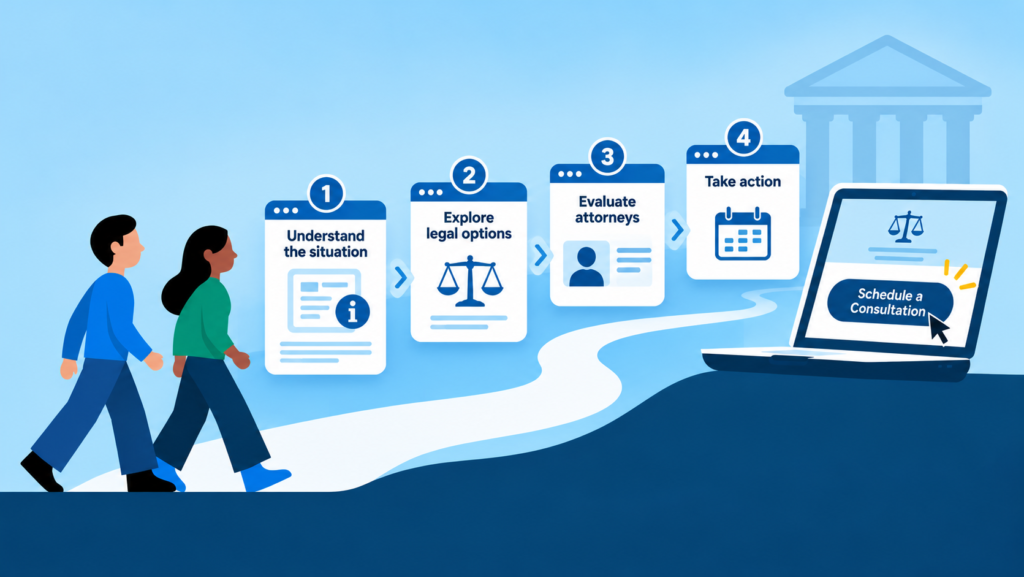
A law firm with several practice areas grows from search when each practice it wants more of has one clear page, supporting content that answers real client questions and links that tie the two together. Most stalled multi-practice sites have the opposite: every practice crammed onto one page, or several pages answering the same question.
This guide shows how to tell which problem your site has, what a sound structure looks like and how to decide which pages to keep, merge, split or build. One illustrative firm runs through every example. Structure is a foundation, not a guarantee, and we say plainly where it stops helping.
The short version
- Give each practice the firm wants to grow one page with one job.
- Build a separate page only when a service has its own client, its own question or enough to say. A keyword variation is not a reason.
- Before merging or deleting a page, check which searches it actually receives and whether it brings in inquiries.
- Google says its AI features have no extra requirements beyond standard SEO, so the same clear structure serves both.
Three ways multi-practice sites go wrong
Firms rarely plan a messy site. It builds up one page at a time, usually when a new practice is added or a past vendor targets a new keyword. The result tends to take one of three shapes.
1. One page tries to cover everything
A single "Practice areas" page gives each service a short paragraph. Someone searching for an estate planning lawyer lands on a page that is mostly about contract disputes. Neither the reader nor Google can tell what the firm actually does well in any one area.
2. Several pages answer the same question
"Business lawyer," "Business attorney" and "Small business legal services" sit on three URLs with near-identical text, each written for a slightly different phrase. The pages split attention between them, and the one that shows up in search may not be the one the firm would choose.
3. Useful articles lead nowhere
The blog answers good questions, but no article links to the service page it relates to. A reader who is ready to call has to hunt for the next step, and the service page misses the support those articles could give it.
Is it structure, or something else?
Structure is one cause of weak search performance among several. A practice page can also underperform because competitors have more reviews, more links from other sites or a stronger local presence, or because the page isn't indexed at all. Before reorganizing anything, look for signs that structure is the problem:
- Two or more of your URLs appear for the same search in Google Search Console.
- An important practice page has few or no links from the rest of the site.
- Your general practice areas page is collecting searches that a dedicated page should be answering.
If none of these apply, start with the wider factors covered in how search engines rank law firms.
Build the hierarchy around the work you want
Take a hypothetical nine-lawyer firm that handles business law, employment law for employers and estate planning. Its clients overlap: the owner who forms a company with the firm may later need help with a workplace complaint and a succession plan. A sound structure for that firm looks like this.
- Practice areas overview routes visitors to the right practice
- Business law
- Business formation
- Contracts
- Buying or selling a business
- Employment law for employers
- Handbooks and workplace policies
- Workplace investigations
- Estate planning
- Wills and trusts
- Business succession planning also linked from business law
- Business law
- Articles each links to the page it supports
- Attorney profiles linked from the practices each lawyer leads
Each level has one job:
- The overview page is a directory. It says what the firm handles and sends each visitor to the right practice.
- Each practice page is the firm's main page for that work: what it covers, for whom, where and who leads it.
- Service pages exist only where a narrower need deserves its own answer.
- Articles answer specific questions and point readers to the practice that can help.
Notice the succession planning page. It belongs to estate planning, but business owners are the people who need it, so the business law page links to it too. Cross-links like this show a firm's real strength: it can serve the same client across several needs.
The hierarchy should follow the work the firm wants more of and the words clients use to describe their problem. It is not a page-count formula. A firm that takes an occasional probate matter doesn't need a probate section.

Decide when a practice needs its own page
This is where most structural decisions go wrong. Ask four questions before creating a page:
- Does the firm want more of this work, and can it take it on? A page invites inquiries. Don't build one for work you would turn away.
- Is the client different? An employer facing a complaint and a family planning an estate need different pages.
- Is the question different? Would a person searching for this be poorly served by landing on the parent page?
- Is there enough to say? A page needs real substance, not a renamed copy of its neighbor.
| What the answers show | What to build |
|---|---|
| Yes to all four | A dedicated page, linked from its parent practice |
| A distinct question, but little to say yet | A section on the parent page, promoted to its own page later if demand grows |
| Same client and question, different wording | No new page. Use that wording naturally on the existing page |
| Work the firm doesn't want more of | A brief mention on the overview, or nothing |
What a useful practice page covers
- What the firm handles in this area, and what it doesn't
- Who the service is for, in the client's own terms
- Where the firm practices: the state, the courts or the offices that matter
- Which lawyers lead the work, linked to their profiles
- How a matter usually begins and what the first conversation covers
- Links to related services and to the articles that answer common questions
Find pages that overlap or compete
When two of your pages compete for the same search, SEOs call it keyword cannibalization. It is real, but often misdiagnosed. Similar keywords alone don't prove it. A practice page and an article can both appear for one search and serve different readers perfectly well.
Check the data before changing anything. In Google Search Console, open the Performance report, filter by a search you care about, then look at the Pages tab. If several of your URLs receive impressions for the same search over the same period, open each one and compare its title, main heading and purpose.
| What you find | What it usually means | What to consider |
|---|---|---|
| Two pages answer substantially the same question | They split attention | Improve the stronger page, merge the other into it and redirect the old URL |
| Two pages serve different needs but read alike | Each page's purpose is unclear | Rewrite titles and openings so each states its own job, then link between them |
| A useful page is hard to reach | Few or no links point to it | Add it to navigation or link it from its parent and related articles |
| A page has little useful content | It is thin | Expand it, fold it into its parent or remove it with a redirect |
Don't delete a page just because its traffic is low. A page that brings in a few qualified inquiries a quarter is earning its place. Check your intake records before you cut anything, and redirect any URL you retire so links and bookmarks still work.
Connect related pages with internal links
Google uses links to find new pages and as a signal of how pages relate. Its guidance says links should be standard HTML anchor elements with an href attribute, which most website builders produce by default. It also says link text should be descriptive and concise, and warns that if you feel you're forcing keywords into it, you've gone too far.
For a multi-practice site, links should run three ways:
- Down: from the overview to each practice, and from each practice to its service pages.
- Up: from each service page back to its practice, so readers can see the wider offering.
- Across: from each article to the service page it supports, and between practices where clients overlap.
In our example firm, an article on what an employer should do after a harassment complaint would link to the workplace investigations page with text such as "how we handle workplace investigations." That sentence makes sense to a reader, and it tells Google what the destination page is about.
Avoid linking every page to every other page, using "click here" or forcing the same exact-match phrase into every link. Structure and linking are the second stage of our SEO and GEO process for law firms, after the audit, because everything later depends on them.
How clear structure supports AI search visibility
Firm owners increasingly ask how to get their firm recommended by ChatGPT or cited in Google's AI answers. Site structure is part of that answer, though not all of it.
Google states that there are no additional requirements or special optimizations needed to appear in AI Overviews or AI Mode. A page must be indexed and eligible to show in search with a snippet. Among the fundamentals Google lists for these features are making content easy to find through internal links and keeping important content in text. It also says no special AI text files or schema markup are needed.
For ChatGPT, OpenAI's crawler documentation says sites that opt out of its search crawler, OAI-SearchBot, won't be shown in ChatGPT search answers. Ask whoever manages your site to confirm that your robots.txt file and any firewall settings don't block it.
Beyond access, our judgment is that the same clarity helps every system. A page that states plainly what the firm handles, where and who leads the work is easier for any system to summarize accurately than a page that blends five practices together.
The limits matter just as much. No structure guarantees a citation, a recommendation or a referral. AI systems don't publish ranking models, so anyone claiming a formula is guessing. For the wider picture, read how to get your law firm recommended by ChatGPT and how AI systems interpret and reference law firms.
A seven-step structure audit you can run this month
This audit finds candidates for change. It doesn't make the decisions for you, but it shows where to look first.
- List the practices you want to grow and the URL serving each. Any practice without a URL is a gap. Any practice with two is a likely overlap.
- Write one sentence describing each page's job. Say who it is for and what question it answers. If you can't write that sentence, the page lacks a purpose.
- Mark overlaps. Pages whose sentences read the same are your first candidates to merge or sharpen.
- Check reach. Every practice page should be one click from the overview, and every service page one click from its practice.
- Check the evidence. For each suspected overlap, compare the searches each URL receives in Search Console over the last three months. Then check which pages bring in inquiries.
- Prioritize. Rank fixes by business value, strength of evidence and effort. Start with the practice the firm most wants to grow.
- Record a baseline, then review. Note impressions, clicks and qualified inquiries for each practice before changing anything. Structural fixes can show in Search Console within weeks. Changes in new clients usually take months.
For a fuller checklist that goes beyond structure, see our law firm SEO audit guide.
Where structure stops helping
A clean structure makes every other investment work harder, but it can't replace them. It won't:
- Outweigh a competitor with far more reviews and local authority in your market
- Turn a thin page into a useful one; the content still has to answer the client's question
- Convert inquiries that reach voicemail or wait a day for a reply
That's why we measure structural work by qualified inquiries and new clients, not by page counts or rankings alone.
Build the structure before adding more pages
Publishing more content on a tangled site usually adds to the tangle. Give each practice a clear purpose, build supporting pages only where they meet a distinct need and connect related pages so readers and search systems can follow the path. Then add content into a structure that can hold it.
See how your site's practice pages fit together
Send us your website. We'll map your practice pages, show where they overlap or go unlinked and tell you what we would fix first.
Request a free site audit Explore website SEO for law firmsSources
- Google Search Central, AI features and your website, last updated Dec. 10, 2025
- Google Search Central, Link best practices for Google
- Google Search Central, Creating helpful, reliable, people-first content, last updated Oct. 5, 2026
- OpenAI, Overview of OpenAI crawlers
All sources checked Oct. 23, 2026. The example firm and site structure are illustrative.