No one can make ChatGPT recommend your law firm. OpenAI’s own help page says of results in ChatGPT search, “Placement is not guaranteed.” No SEO agency can promise otherwise for any question, city or prospective client.
What you can control is whether ChatGPT can reach your website, tell what your firm handles and confirm that the details are true. The seven steps in this guide work on those three things. A fourth, measurement, tells you whether the work paid off.
One caution before you start. A mention is not a client, and a website visit is not a signed case. The point of this work is for the right prospective clients to find your firm, and for you to be able to measure whether that brings in new business.
The short answer
ChatGPT names firms it can find, understand and verify. The seven steps, in order:
- Make sure ChatGPT search can access your website
- Build practice area pages around the matters you actually handle
- Answer prospective clients’ real questions
- Make lawyer experience easy to verify
- Keep your firm’s public information consistent
- Fix foundational SEO before buying AI-specific tactics
- Test AI visibility and connect it to new matters
Also in this guide: What AI assistants look for Worked example What to do first How long it takes What not to do FAQ
What AI assistants look for before naming a firm
When someone asks ChatGPT to recommend a lawyer, it usually searches the web and writes its answer from what it finds. OpenAI does not publish how it chooses the firms it names. It does describe the outline, and ChatGPT shows its sources, so part of the process can be observed.
- The question becomes several searches. OpenAI says ChatGPT search typically rewrites a prompt into one or more targeted queries, and may use the person’s general location to do it. “A good divorce lawyer near me” becomes a search that names the city.
- It collects pages and sources. These come from OpenAI’s own crawler and from other search providers. For legal questions, the sources shown in answers often include firm websites, legal directories, reviews and news coverage.
- It keeps what it can use. OpenAI says results are ranked on several factors meant to surface relevant, reliable information. It does not list them.
- It writes one answer and names a few firms. The answer links to the sources it drew on.
Sometimes ChatGPT answers from what it learned in training, without searching. You cannot test or correct that directly, which is one more reason to keep public information about your firm accurate over time.
Put together, an AI assistant can only name a firm it found, understood and could check against other sources. Our guide to how AI recommends law firms looks at how this differs from one AI tool to the next.
What does it mean for ChatGPT to recommend a law firm?
Before changing your website, define what success means for your firm. An AI answer can lead to six different outcomes:
- MentionChatGPT names your firm.
- CitationChatGPT links to your site or to another source about your firm.
- Referral visitSomeone follows a link to your website.
- Qualified inquiryA prospective client contacts you about a matter you handle.
- ConsultationThe inquiry becomes a scheduled or completed consultation.
- New matterThe firm accepts the engagement or signs the case.
These outcomes are not interchangeable. A firm can be mentioned without receiving a website visit. A visitor may never contact the firm. An inquiry may not become a new matter.
Measure the stages your firm counts. A consumer-facing firm may track qualified calls, consultations and signed cases. A business-facing firm may track qualified inquiries, pitch invitations and new matters.
Start by establishing where your firm stands today. Then identify which improvements the evidence supports.
The four-part framework: Access, Clarity, Corroboration and Measurement
Found, understood, checked and measured: those four ideas turn a broad goal, appearing in ChatGPT answers, into specific questions a law firm can investigate.
| Area | Diagnostic question | What to investigate | Steps |
|---|---|---|---|
| Access | Can ChatGPT search reach your important pages? | Crawler access, technical barriers and internal links | 1, 6 |
| Clarity | Can a reader tell what the firm handles? | Practice pages, lawyer biographies and useful answers | 2, 3 |
| Corroboration | Can a reader verify the firm’s identity and details? | Accurate profiles, credentials and consistent public details | 4, 5 |
| Measurement | Can the firm see what happens next? | AI visibility tests, referral visits, intake and new matters | 7 |
This is a practical diagnostic framework, not an official ChatGPT ranking model. It does not claim to explain every factor an AI system uses to select sources.
Its purpose is to help your firm identify a specific problem before paying for a proposed solution.
Step 1Make sure ChatGPT search can access your website
Access comes first for a reason: a page ChatGPT cannot read cannot be quoted, however good it is. Check this before investing in more content.
OpenAI uses crawlers, programs that read web pages, and it uses separate ones for separate jobs:
- OAI-SearchBot finds pages to show in ChatGPT search. OpenAI says sites that opt out of it will not be shown in ChatGPT search answers.
- GPTBot collects content that may be used to train OpenAI’s generative AI models.
- ChatGPT-User visits a page when a person asks ChatGPT to. OpenAI says it plays no part in deciding whether content appears in search.
Each setting is independent of the others. A website can allow OAI-SearchBot while disallowing GPTBot, depending on the firm’s preferences. The instructions sit in robots.txt, a small file that tells crawlers which pages they may read. That combination looks like this:
User-agent: OAI-SearchBot
Allow: /

User-agent: GPTBot
Disallow: /
An example, not a recommendation. Whether to allow GPTBot is your firm’s decision.
OpenAI says a robots.txt change takes about 24 hours to take effect in search. Review OpenAI’s crawler documentation before changing your settings, because the details change.
What your developer or SEO provider should check
- Whether important practice area and lawyer pages are publicly accessible.
- Whether robots.txt unintentionally blocks OAI-SearchBot.
- Whether your hosting, security rules or content delivery network (the service that delivers your pages to visitors) turns away requests from the addresses OpenAI publishes for its search crawler.
- Whether important content is available as readable text in the page itself.
- Whether pages load without errors and can be reached through internal links.
- Whether unnecessary redirects or other technical barriers prevent access.
- Whether your site is indexed in Bing as well as Google. OpenAI’s help page points to Microsoft as one of the search providers ChatGPT search may send queries to.
If your firm wants to restrict training-related crawling, assess GPTBot separately. Do not assume that blocking it has the same effect as blocking OAI-SearchBot.
Allowing a crawler removes one potential barrier. It does not guarantee that ChatGPT will mention, cite or recommend your firm.
Step 2Build practice area pages around the matters you actually handle
Prospective clients describe a problem. They rarely use a law firm’s internal service categories.
A broad page titled “Legal services” does not say which matters the firm handles. Specific pages do. A family law firm that handles divorce, child custody and child support can give each its own page. So can a business litigation firm that handles commercial contract disputes, partnership disputes and business fraud matters.
If those are real practice areas, each page can explain the issues, the process and how to contact the firm. Each page should answer six questions:
- Who does the firm help? Describe the relevant clients where accurate.
- What matters does the firm handle? Identify specific disputes, transactions or legal issues.
- Where does the firm operate? Describe relevant locations and jurisdictions without overstating coverage.
- What should a prospective client understand? Explain the process and common considerations.
- Who handles the work? Link to the relevant lawyers’ biographies and verifiable experience.
- What is the next step? Give a clear, appropriate way to contact the firm.
Avoid creating dozens of near-identical city pages that differ only by location name. Each page should provide useful information about the service and location it describes. Google’s spam policies cover pages produced at scale mainly to manipulate results, and such pages give an AI assistant nothing new to quote.
A simple quality test: ask someone unfamiliar with the firm to read a practice area page. Can they explain what the firm handles, whom it serves and where it operates? If not, improve the page before expanding the site.
Step 3Answer prospective clients’ real questions
People use AI assistants to explore a legal problem before deciding whether to contact a lawyer. Your content should address those questions directly, accurately and in plain English.
Start with the questions your lawyers and intake team hear repeatedly. Depending on the firm’s practice, examples might include:
- What documents should I bring to a divorce consultation?
- Do I need a lawyer for a marriage-based green card application?
- What should I preserve after a contract dispute?
- What is the difference between mediation and litigation?
- What should a business owner consider before signing a settlement agreement?
- What questions should I ask before hiring a lawyer for this type of matter?
Choose questions relevant to your actual practice areas, locations and prospective clients. Do not publish content simply because a keyword tool suggests it.
Use a repeatable content structure
For each substantial question:
- Answer it directly. Give readers a useful starting point without burying the answer in a long introduction.
- Explain what can change the answer. Identify relevant facts, jurisdictional differences and circumstances that require individual legal advice.
- Provide a practical next step. Explain what information someone may need or how to prepare for a discussion with counsel.
- Add what only your lawyers know. How matters of this kind run in your local courts, or the mistakes clients commonly make, is detail no other site has. Google’s guidance makes the same point about its own AI features: content anyone could have written adds little.
- Show who reviewed it. Use accurate author information and review dates where appropriate.
- Link to supporting pages. Connect readers with the relevant practice area, lawyer biography or related explanation.
For example, an article about preparing for a business litigation consultation could explain why contracts, correspondence and a timeline of events may help the discussion. It should not suggest that the same checklist fits every dispute.
AI tools can help with research and drafting, but they should not replace substantive legal review. Publishing more articles is not inherently better than publishing fewer, more useful ones.
Step 4Make lawyer experience easy to verify
Choosing a lawyer involves trust. Prospective clients may want to know who will handle their matter, whether that lawyer works on similar issues and which credentials are relevant.
Review each lawyer’s biography for:
- Accurate name, title and current role.
- Relevant bar admissions and jurisdictions.
- Education and professional credentials.
- Practice areas that reflect the lawyer’s actual work.
- Relevant experience described with appropriate context.
- Publications, speaking engagements and professional roles that can be verified.
- Links to the services the lawyer handles.
Avoid unsupported claims such as “the most trusted lawyer in the state.” Do not invent awards, inflate case outcomes or imply that prior results predict future outcomes.
If you publish case results, testimonials or client examples, have the appropriate reviewer assess accuracy, confidentiality, context and applicable professional-conduct requirements.
Lawyer advertising rules vary by state and change over time. Have the firm confirm its obligations with ethics counsel or its state bar. A general SEO article is not the place to get a legal conclusion.
The objective is information a reader can verify. Louder marketing language does not help. Named authors with checkable credentials are also part of how lawyers become cited sources in AI summaries.
Step 5Keep your firm’s public information consistent
Your website is not the only place prospective clients may encounter information about your firm.
Bar profiles, established legal directories, professional biographies and public business listings such as your Google Business Profile may also contain relevant details. Conflicting information makes it harder for people to confirm that they have found the right practice.
Create an inventory of your most important profiles and check:
- Firm name and website.
- Phone number and contact details.
- Office addresses and service areas.
- Lawyer names, titles and biographies.
- Practice areas.
- Business hours and operating status, where displayed.
Prioritize authoritative and relevant sources. An accurate bar profile is more useful than a collection of low-quality listings created solely to increase the firm’s online footprint.
Do not manufacture mentions, buy misleading endorsements or create fake reviews. A mention on another website is not automatically an endorsement, and more mentions do not guarantee a recommendation.
When an AI answer states something wrong about your firm, no one can edit the answer. Find the page or listing the fact came from and correct it there.
The practical objective is to make your firm’s identity, services and relevant credentials easier to verify. Profiles, listings and reviews are the work of local SEO for law firms.
Step 6Fix foundational SEO before buying AI-specific tactics
You may hear providers describe their services as answer engine optimization (AEO) or generative engine optimization (GEO). Some work under these labels is useful. The label alone does not establish that a tactic is necessary or effective.
Google’s guidance is direct on this. It says optimizing for its AI search features is “still SEO.” It says those features need no special AI files or added structured data. It also says Google Search ignores llms.txt files, a proposed text file that lists a site’s pages for AI tools. It also warns that no third-party tool has access to its internal ranking or AI systems.
That guidance applies to Google’s products. It is not an explanation of how ChatGPT selects sources. OpenAI’s published requirement is shorter still: let its search crawler in.
Before purchasing an AI-specific service, ask the provider:
- What specific problem are you trying to solve?
- What evidence supports the proposed change?
- How will we measure whether it helped?
Prioritize foundational work such as:
- Making important pages crawlable and eligible for indexing.
- Improving navigation and internal links.
- Writing descriptive page titles and useful headings.
- Ensuring important information is available in readable text.
- Improving mobile usability and page speed where needed.
- Keeping structured data, the code that helps search engines read a page, consistent with what the page visibly says.
- Correcting broken links and unnecessary duplication.
- Publishing original, lawyer-reviewed information that helps prospective clients.
Do not assume your firm needs a special AI text file, a new schema type or a large batch of AI-generated pages. Ask for a specific, supported reason before funding an unfamiliar tactic.
This groundwork is what website SEO for law firms covers. GEO and AI SEO for law firms builds on it.
Useful primary sources include Google’s AI features guidance, its guide to optimizing for generative AI features and its guidance on third-party SEO advice.
Step 7Test AI visibility and connect it to new matters
Do not accept a provider’s claim that your firm is “visible in AI” without asking what was tested.
AI responses vary. One prompt, screenshot or isolated mention does not establish consistent visibility or business impact. Build a small, repeatable testing process instead.
This step is last because it never ends. Its first part, the baseline, belongs before any other work, so you have something to compare against.
Establish a baseline
Choose realistic questions prospective clients might ask. Include variations in wording, practice area and location where relevant. Two hypothetical test sets:
A consumer-facing firm: family law in Tampa
- “How do I choose a divorce lawyer in Tampa?”
- “Which lawyers in Tampa handle child custody cases?”
- “What should I ask a family lawyer at a first consultation?”
- “How does child support work in Florida?”
A business-facing firm: business litigation in Austin
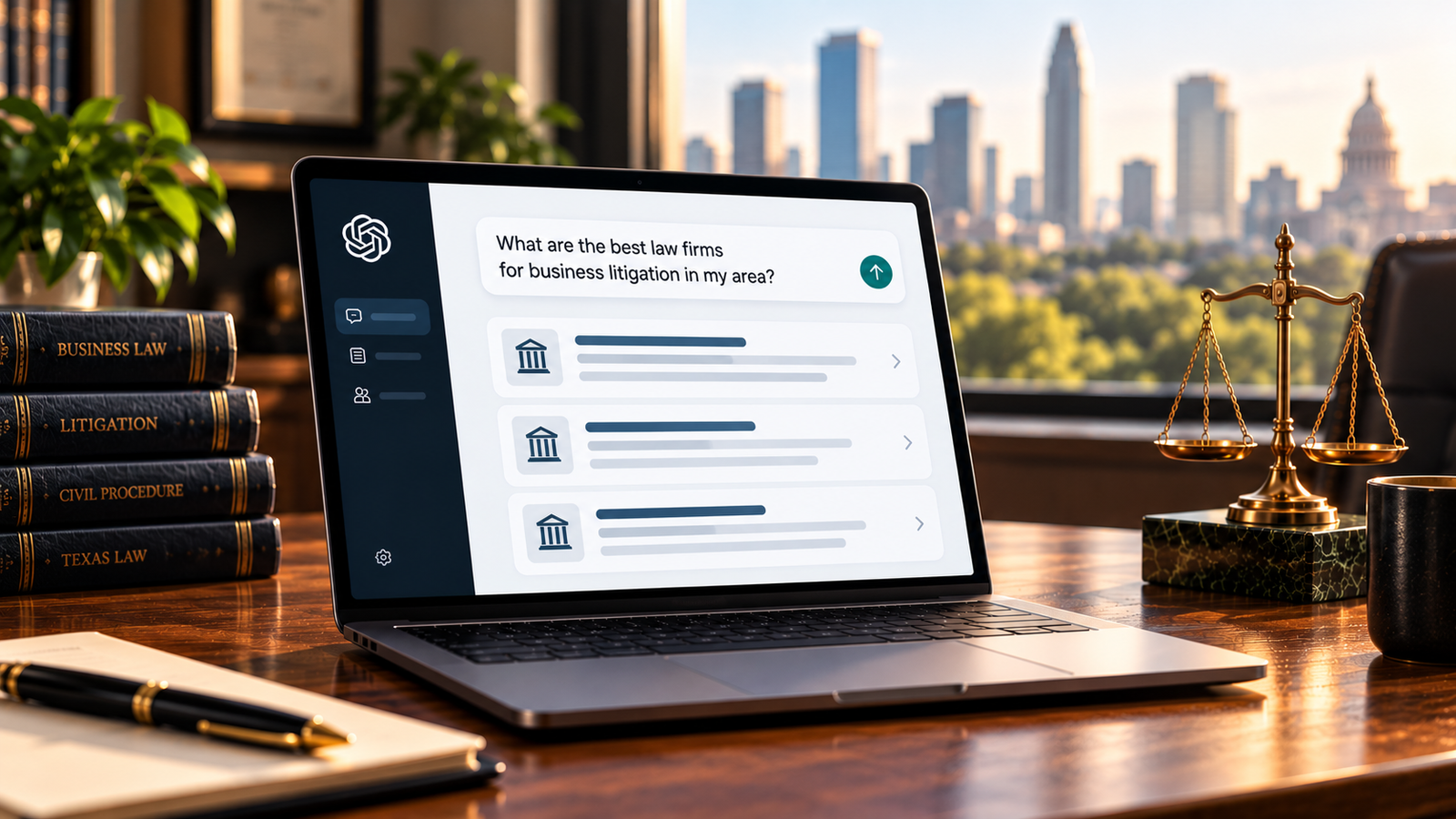
- “What should I look for in a business litigation lawyer in Austin?”
- “Which lawyers in Austin handle commercial contract disputes?”
- “What should a business owner ask before hiring litigation counsel?”
- “What are the options for resolving a business contract dispute in Texas?”
These are illustrative prompts for fictional firms, not recommendations about any real lawyer.
Record the exact prompt, date and product used. ChatGPT may use the searcher’s general location, so name the city in the prompt or run the test from the market you serve. Run each prompt more than once, and repeat the same set at planned intervals so results can be compared.
If you would like to see this done for your firm first, our free audit includes this check.
Record what happened
| Field | What to record |
|---|---|
| Date | When the test was run |
| Prompt | Exact wording |
| Product | ChatGPT search or another identified experience |
| Firm mentioned | Yes, no or unclear |
| Firm cited | The actual linked source, if present |
| Relevant page | The firm’s page, if one appeared |
| Other sources shown | Relevant sources in the response |
| Next action | A specific issue to investigate |
Do not call the firm “invisible” because it failed to appear in one response. Report the number of prompts tested, the dates and the results. If you calculate a percentage, show the underlying count.
The same standard applies to any report an agency sends you:
- A line you can check
- “ChatGPT named the firm in 4 of 20 test runs in October, up from 1 of 20 in July (source: prompt log). Two visits from ChatGPT became qualified inquiries (source: analytics and intake log).”
- A line you cannot
- “Your firm is now visible in AI.”
The figures are invented to show the format. They are not client results.
Turn observations into an evidence-based audit
Suppose the fictional Austin firm is absent from several relevant test responses. One response cites a legal directory, another cites an explanatory article and a third includes no relevant local firm.
These observations do not prove why the firm was omitted. They do suggest questions worth investigating:
- Can ChatGPT search access the firm’s practice pages?
- Do those pages explain its services and locations clearly?
- Is the lawyer information current and verifiable?
- Are the sources being cited accurate and relevant?
- Does the firm’s website answer the questions being tested?
Each question leads to a testable action. That is more useful than claiming to know exactly why an AI system selected a particular source.
Connect visibility with website activity
OpenAI’s publisher FAQ says ChatGPT adds a tag, the UTM parameter utm_source=chatgpt.com, to the links people follow from its search results. Analytics tools such as Google Analytics can count those visits.
Check that your analytics setup records these referrals correctly. Where data is available, track:
- Referral visits from ChatGPT.
- Pages visited after the referral.
- Contact-form submissions.
- Tracked calls associated with those visits.
- Qualified inquiries associated with those contacts.
Referral tracking will not capture every influence on a prospective client’s decision. Someone may discover your firm through an AI answer and return later through another channel.
For Google’s own AI features, Google points site owners to the Generative AI performance report in Search Console.
Connect activity with intake and new matters
Your intake process should record how prospective clients say they found the firm. Capture that information consistently and compare it with analytics and call-tracking data.
Then track the business outcomes that matter:
- Qualified inquiries.
- Consultations scheduled and completed.
- New clients, signed cases or new matters.
- Cost per new client, where cost and attribution data support the calculation.
Do not claim that AI search caused an increase in signed cases simply because both occurred during the same period. Other marketing campaigns, referrals, seasonality and intake changes may also contribute.
Good reporting separates what was observed, what was inferred and what remains unknown.
Worked example: prioritizing an AI-search audit
Consider the hypothetical business litigation firm in Austin. It has an established website but has not assessed its visibility in ChatGPT.
An initial review identifies four issues:
- The main practice page says “business law” but does not explain the disputes the firm handles.
- Lawyer biographies list education but provide little relevant practice information.
- Several public profiles contain outdated contact details.
- The firm has no repeatable AI visibility tests or consistent record of AI-attributed inquiries.
The four-part framework turns those findings into a practical action plan.
| Area | Evidence to collect | Proposed action | Follow-up measure |
|---|---|---|---|
| Access | robots.txt, crawler access and page status checks | Correct any confirmed technical barriers | Recheck access and page status |
| Clarity | Review of the practice page against actual services | Rewrite the page to describe relevant disputes | Review page quality and repeat the same prompt tests |
| Corroboration | Comparison of key public profiles | Correct outdated details | Confirm the important profiles are accurate |
| Measurement | Initial prompt log and analytics review | Establish a repeatable baseline and intake tracking | Compare observations at planned intervals |
The firm should not assume that any single change will make ChatGPT recommend it. It should implement relevant improvements, record when they were made and compare subsequent observations.
This is a diagnostic example, not a client case study or a report of measured results.
What should your law firm do first?
Use this order as a starting point. It differs from the step numbers in one respect: the baseline moves to the front, because without a starting point you cannot tell whether later work helped. An audit may reveal a reason to change the sequence.
| Order | Action | Why it matters | Step |
|---|---|---|---|
| 1 | Record an AI visibility baseline | Creates a basis for comparison | 7 |
| 2 | Check crawler access and technical barriers | Important information must be accessible to be considered | 1 |
| 3 | Improve core practice area pages | Readers need to understand the firm’s services | 2 |
| 4 | Verify lawyer and firm information | Accurate details support clarity and trust | 4 |
| 5 | Correct important public profiles | Reduces conflicting information | 5 |
| 6 | Answer the questions clients ask | Gives an AI assistant something specific to quote | 3 |
| 7 | Connect analytics with intake | Shows whether identifiable activity contributes to new matters | 7 |
| 8 | Consider additional AI-specific work | Invest only when the need and the measurement are clear | 6 |
A firm with a technically sound website may need to focus on content or attribution sooner. A firm with significant access barriers should address those before expanding its content library.
How long does it take to get recommended by ChatGPT?
There is no reliable universal timeline for getting a law firm recommended by ChatGPT.
One interval is documented: OpenAI says a robots.txt change takes about 24 hours to take effect in search. Past that, content has to be crawled and evaluated, responses vary and some changes produce no visible difference.
One firm’s account, for scale. The lead attorney of an immigration law firm we work with told us: “Within 60 days, our firm began appearing in generative AI summaries for the immigration questions our ideal clients ask.” That is one firm in one practice area. It is not a forecast for yours, and appearing in a summary is the first of the six outcomes above, not the last. Our case studies show more.
A responsible SEO provider should distinguish between work completed, early indicators and business outcomes. A planned review date is useful for managing the work. It is not a guarantee that an AI system will change its answers by then.
Set expectations around the firm’s starting point, the scope of work and the data available. Judge progress by repeatable tests and business outcomes, not by a promised recommendation date.
What not to do when trying to appear in ChatGPT
Avoid tactics that create activity without a credible path to better information or measurable results.
- Do not buy guaranteed recommendations. No provider can guarantee that ChatGPT will name your firm for a given prompt.
- Do not publish large volumes of generic AI content. Content should add useful information and receive appropriate review.
- Do not manufacture mentions or reviews. Misleading public information creates trust and compliance risks.
- Do not add technical markup without a reason. It should accurately describe the page and serve a supported purpose.
- Do not treat a screenshot as proof of business impact. Record the prompt, date, source and repeatability of the observation.
- Do not ignore intake. More inquiries will not solve the problem if calls go unanswered or prospective clients are handled inconsistently.
- Do not assume every practice area needs the same strategy. Consumer-facing and business-facing firms may need different content and success measures.
The practical approach is to fix demonstrable problems, test carefully and expand only when the evidence supports it.
Frequently asked questions
Can an SEO agency guarantee that ChatGPT will recommend my law firm?
No. OpenAI states that placement in ChatGPT search is not guaranteed. An agency can assess your website, improve technical access, strengthen relevant content and measure observed visibility. It cannot guarantee that ChatGPT will recommend your firm for a particular question or location.
Is ChatGPT SEO different from traditional SEO?
Some practical work overlaps, including crawl access, useful content, clear site structure and accurate public information. Different AI products may select and present sources differently. Focus on sound fundamentals and measure what you can observe. There is no universal AI-ranking formula. Our briefing on SEO vs. GEO for law firms covers how the two fit together.
Should my law firm block GPTBot?
That depends on your firm’s preferences. OpenAI distinguishes OAI-SearchBot, which helps surface websites in ChatGPT search, from GPTBot, which collects content that may be used to train its models. The two settings are independent. Review the official documentation and make the decision deliberately.
Does my firm need an llms.txt file?
An llms.txt file is a proposed text file that lists a site’s pages for AI tools. You do not need one for Google, which says its search ignores them. OpenAI’s guidance for publishers on appearing in ChatGPT search does not mention one (checked October 2026). Start with crawl access, useful content, technical SEO and measurement. Consider additional files only when there is a clear, supported reason.
Does appearing in ChatGPT mean my firm will get more clients?
Not necessarily. A mention may not include a link, a visitor may not contact the firm and an inquiry may not become a new matter. Track each stage separately and avoid claiming causation without supporting evidence.
Should I stop investing in Google SEO to focus on AI search?
Not on the basis of AI visibility alone. Google says established SEO fundamentals remain relevant to its AI search features, which draw on the same search index. Evaluate marketing channels against qualified inquiries, new matters, costs and the firm’s broader objectives.
How can I tell whether ChatGPT sends visitors to my website?
Review your analytics referral reports and verify that ChatGPT referrals are being captured correctly. OpenAI documents the use of utm_source=chatgpt.com in referral links. Also ask prospective clients how they found the firm, because analytics may not capture every influence on their decision.
The bottom line
Getting your law firm recommended by ChatGPT has no guaranteed formula. It is ongoing work to make your firm accessible, understandable and verifiable, and then to measure what happens.
Start with the fundamentals:
- Make sure important pages are accessible.
- Explain your actual practice areas clearly.
- Keep lawyer and firm information accurate.
- Answer prospective clients’ real questions.
- Test AI visibility consistently.
- Connect identifiable activity with qualified inquiries and new matters.
You do not need to fund every new AI optimization tactic. Identify the problems you can verify, prioritize the work and distinguish evidence from assumptions.
The business objective remains the same: the right prospective clients find your firm and make an informed decision about contacting you.
How Serptone Legal can help
Serptone Legal does SEO for US law firms and no one else. If you are unsure whether your firm’s biggest gap is technical access, practice area content, local visibility or attribution, start by finding out what can be verified.
Our free audit checks what the main AI tools say when asked about your practice areas in your city, which firms they name and what they say about yours. It includes a 30-minute strategy consultation. It is confidential and carries no obligation.
A useful first conversation should clarify:
- Which practice areas and locations matter most to your firm.
- Whether your website and public information have identifiable issues.
- How you currently track qualified inquiries, consultations and new matters.
- Which improvements deserve priority and how progress can be evaluated.
You will leave with a clear assessment of what needs attention. You will not get a promise that an AI platform will recommend your firm.
Sources and further reading
- OpenAI: Searching the web with ChatGPT. How ChatGPT search rewrites queries, works with other search providers and ranks results. Checked October 2026.
- OpenAI: Overview of OpenAI crawlers. The roles of OAI-SearchBot, GPTBot and ChatGPT-User. Checked October 2026.
- OpenAI: Publishers and developers FAQ. Appearing in ChatGPT search and tracking referral visits. Checked October 2026.
- Google Search Central: AI features and your website. How established SEO practices apply to Google’s AI search features. Last updated Dec. 10, 2025.
- Google Search Central: Optimizing your website for generative AI features on Google Search. Official guidance on content, llms.txt files and measurement. Last updated July 10, 2026.
- Google Search Central: Guidance on using third-party SEO tools, services and advice. Evaluating vendor claims and tools. Last updated June 5, 2026.
Editorial disclaimer: this article provides general marketing information, not legal advice. Law firms should have appropriate personnel review public-facing content and confirm applicable professional-conduct requirements with their state bar or ethics counsel.