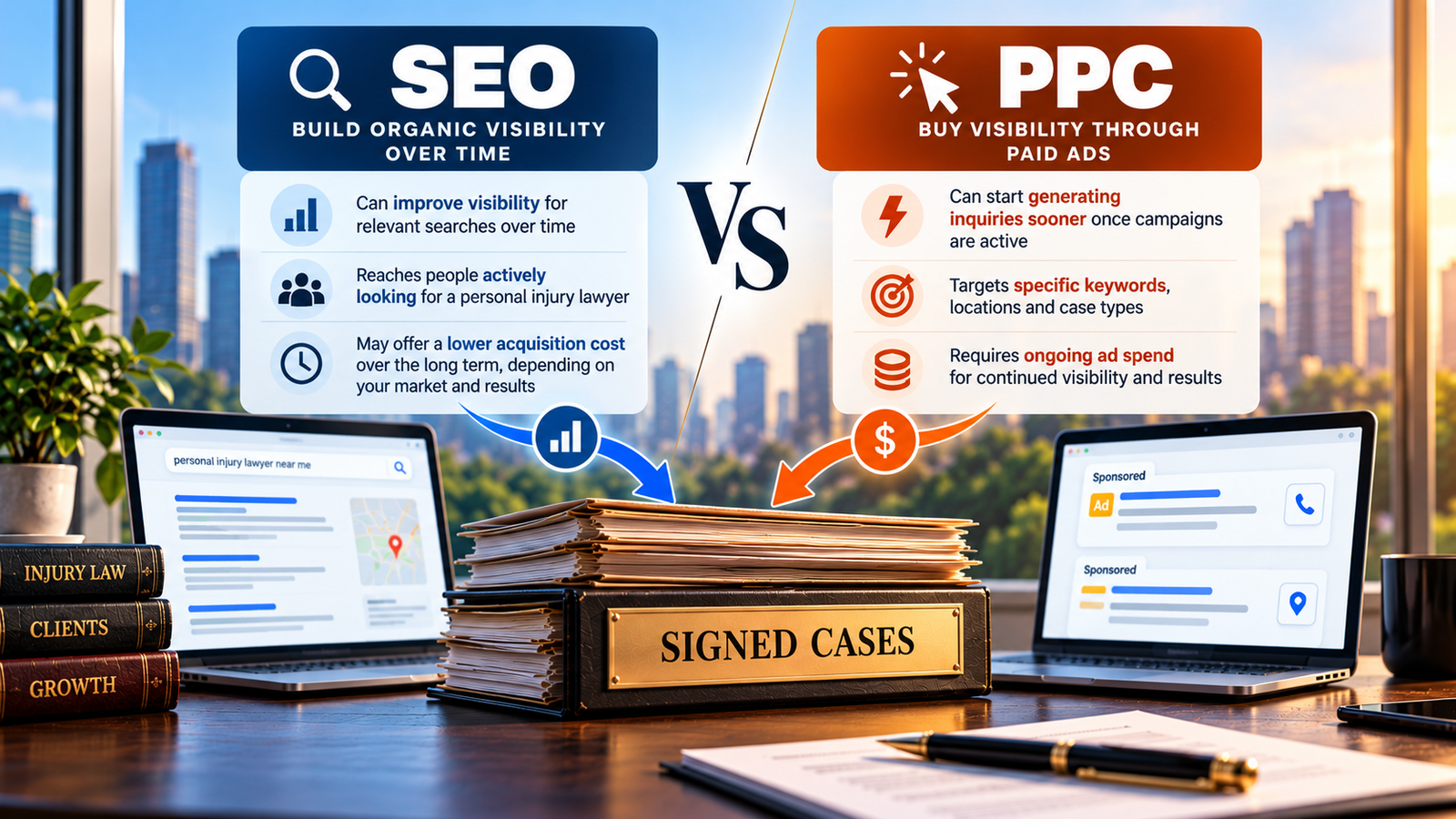
Neither channel brings more signed cases by default. PPC can put your firm in front of injured people searching for a lawyer within days, but you pay for every click, and legal clicks cost more than any other industry's in the most widely cited ad benchmark. SEO takes months to build, but its cost doesn't rise with every visit. The channel that wins is the one with the lower cost per signed case in your market, measured over the same period with the same rules.
For most personal injury firms of one to 15 lawyers, the answer is an order of operations, not a single channel:
- Fix intake and tracking first. If you can't trace a signed case back to where it came from, you can't judge either channel.
- Use PPC when you need cases this quarter, with a spending cap and a cost-per-signed-case limit you set in advance.
- Build SEO alongside it if you can fund 12 months of work, because organic results take time and are judged unfairly over shorter windows.
- Each quarter, move budget toward the channel with the lower cost per signed case, using your own intake records, not an agency's dashboard.
The rest of this article shows how to make that call with your own numbers: what each channel really costs, how fast each can bring in signed cases, how to compare case quality and what to check before spending more on either.
What you are actually comparing
SEO and PPC both put your firm on Google's results page. They get there in different ways and charge you in different ways.
PPC (pay-per-click) means buying ad space on Google or Microsoft. Your ad shows when someone searches a term you bid on, and you pay each time someone clicks. When you stop paying, the ads stop showing.
SEO (search engine optimization) means improving your website and Google Business Profile so they appear in the unpaid results and the map results. You pay for the work, not for each visit. Google states plainly that it never accepts money to rank sites in its organic results, and that advertising with Google has no effect on them.
| Factor | SEO | PPC |
|---|---|---|
| What you pay for | Ongoing work on your site, content and Google Business Profile | Each click, plus management, landing pages and tracking |
| Time to first visibility | Weeks for local fixes; months for competitive terms | Usually days, once ads pass Google's review |
| How cost behaves | Mostly fixed each month, whatever the traffic | Rises with every click you buy |
| If you stop paying | Rankings fade gradually, if at all, depending on competitors | Ads stop showing |
| Main risk | Paying for months before results show | Paying for clicks that never become cases |
| What decides success | Cost per signed case over six to 12 months | Cost per signed case over six to 12 months |
The last row is the point of this article. Clicks, rankings and inquiries are steps on the way. Signed cases are the result. If you want a deeper look at what drives organic visibility, see how search engines rank law firms.
Which brings signed cases sooner?
PPC, in most cases. But launching an ad and signing a client are not the same event.
PPC can start within days
Google reviews most new ads within one business day, though some reviews take longer. Once an ad is approved and the campaign is live, it can start showing. That speed is PPC's real advantage when a firm needs cases soon, opens a new office or wants to test demand in a new area.
Two things slow the path from click to signed case. First, someone still has to call, qualify and sign the client, and that depends on your intake. Second, it takes weeks of spending before you have enough signed cases to know whether the campaign pays. A campaign that looks busy in week two can still lose money by month three.
SEO needs a longer window
Organic results depend on your site's starting condition, how competitive your market is and how quickly changes go live. Our working forecast: fixes to your site and Google Business Profile can show within weeks, while changes in signed cases from organic search typically take three to 12 months, longer in dense metro markets. That forecast assumes the work is published on schedule. It is a range, not a promise. No one can guarantee a ranking, and Google itself tells buyers to walk away from anyone who does.
For personal injury, the map results deserve early attention. Someone searching "car accident lawyer near me" often sees the map before any website, and those results are driven largely by your Google Business Profile, reviews and location. That work is the core of local SEO for law firms.
If you need cases now
Run a capped PPC test while SEO work starts. Set the monthly cap, the cost per signed case you can afford and the date you will judge it. Then judge it on that date, not on how the dashboard looks in week one.
How to compare SEO vs PPC cost per signed case
Cost per signed case is the one number that lets you compare the two channels fairly. It only works if you count costs the same way for both.
Count the full cost on both sides
A common mistake is comparing PPC ad spend alone against an all-in SEO fee. That flatters PPC. Count everything on both sides:
- PPC: ad spend, management fees, landing pages, call tracking and any setup fees.
- SEO: the monthly fee, content, technical fixes, Google Business Profile work and any one-off site work.
Ads and landing pages count as lawyer advertising. Rules vary by state and change over time, and some states require ads to be filed or reviewed. Check with your state bar or ethics counsel before launch, and build that time into the schedule.
What legal clicks cost right now
The most widely cited benchmark is WordStream and LocaliQ's 2026 report, based on 13,474 US search campaigns on Google and Microsoft Ads that ran from April 2025 to March 2026. Attorneys and legal services had the highest median cost per click of the 23 industries measured: $9.87, against $5.42 across all industries. Legal also had the highest median cost per inquiry the ads tracked, at $131.63, against $66.69 overall.
Those figures cover the whole legal category, not personal injury alone, and they come from one provider's clients. Treat them as context, not a quote for your market. They do show why the next step matters. An inquiry is not a client. If one in 10 inquiries becomes a signed case, a $131.63 cost per inquiry becomes about $1,316 per signed case in ad spend alone, before management fees. That ratio is illustrative; use your own.
A worked example: the window changes the winner
Here is one firm's first six months on both channels. The numbers are illustrative, not Serptone Legal client data.
| Six months | PPC | SEO |
|---|---|---|
| Monthly all-in cost | $6,000 | $4,000 |
| Total cost, months 1 to 6 | $36,000 | $24,000 |
| Signed cases, months 1 to 6 | 12 | 6 |
| Cost per signed case, months 1 to 6 | $3,000 | $4,000 |
| Signed cases, months 4 to 6 only | 6 | 5 |
| Cost per signed case, months 4 to 6 | $3,000 | $2,400 |
Over the full six months, PPC wins: $3,000 per signed case against $4,000. Over the last three months, SEO wins: $2,400 against $3,000, because its cost stayed flat while results built. PPC's cost per case held steady because every new case required new clicks.
Neither view is wrong. The full-period view tells you what you have spent. The recent view tells you where each channel is heading. Look at both before you move money, and never judge SEO on its first 90 days alone.
Compare the result with your own case economics
Personal injury adds a timing problem. Contingency fees arrive at settlement, often many months after a case is signed. So the fair test today is cost per signed case set against the fee you expect from a typical case, not this month's revenue. Use expected profit, not revenue, because a case that brings in $6,000 at a 50% margin leaves $3,000 to cover the marketing that won it.
Cost per signed case calculator
Enter your own figures for one month. The defaults are illustrative. Nothing you enter leaves this page.
| Result | PPC | SEO |
|---|---|---|
| Cost per signed case | — | — |
| Cases needed to cover cost from profit | — | — |
| Expected profit after marketing | — | — |
Which brings better-quality cases?
You will hear that organic visitors make better clients, or that ad clicks come from people ready to hire. Neither holds as a rule. Quality depends on the search terms, the pages people land on and how your team handles the first call. The only reliable answer comes from your own records, tracked by source.
For each channel, track:
- The share of inquiries that meet your qualification criteria
- The share of qualified inquiries that become signed cases
- The mix of case types you sign, and the ones you refer out or decline
- The expected fee per signed case, where your records support it
- Whether inquiries come from the areas you actually serve
Agree on what counts as a qualified inquiry before you compare anything. If your intake team and your agency define it differently, the numbers will never line up.
When a channel brings plenty of inquiries but few cases
Check intake before you blame the channel. In Clio's 2024 secret-shopper test of 500 law firms, only 40% answered a call from a prospective client, down from 56% in 2019. Firms that miss calls pay for the click and lose the case. Then work through these questions:
- Are calls answered live, including evenings and weekends, when many injury inquiries arrive?
- How quickly does someone follow up on web forms and missed calls?
- Do the PPC search-term reports show irrelevant searches, such as job seekers or people looking for a different practice area?
- Do ads and landing pages match the case types you want to sign?
- Are ads or pages showing outside the areas you serve?
- Does each channel's inquiry reach your intake system with its source attached?
What happens when you stop paying?
If PPC spend stops
Your ads stop showing as soon as the campaign is paused. Clients you already signed stay signed, and the data you gathered stays useful, but new paid visibility ends that day.
If SEO work stops
Organic rankings don't switch off. They can hold for a while, then slip as content ages, technical issues build up and competitors keep working. How fast that happens varies by market. No one can promise rankings will hold, just as no one can promise they will rise.
That difference is why SEO is often called an asset and PPC a rental. It is a useful shorthand, with one correction: SEO is not free once you rank. It needs upkeep, and the upkeep costs money.
Should a personal injury firm run both?
Often, yes, if three conditions hold: the budget can fund both properly, intake can handle the extra calls and both channels feed the same tracking. Running both badly costs more than running one well.
When those conditions hold, the channels help each other:
- PPC fills the gap while SEO builds, so the firm isn't waiting months for any new inquiries from search.
- PPC search-term data shows which phrases turn into signed cases. Those phrases tell you which pages to build or improve for organic search.
- As organic visibility grows, you can test lowering PPC spend on terms where you already rank well, and watch whether total signed cases hold.
Google also sells Local Services Ads, which charge per inquiry rather than per click and appear above standard ads. They are a third paid option worth testing, and the same rule applies: judge them on cost per signed case, not cost per inquiry.
How to choose the right channel for your firm
| If your firm… | Start here |
|---|---|
| Needs signed cases this quarter and can fund advertising | A capped PPC test with a cost-per-signed-case limit and a review date |
| Can fund 12 months and wants a source that doesn't depend on click prices | An SEO plan with a realistic evaluation window and clear monthly reporting |
| Already runs PPC but can't say which ads produced signed cases | Fix call tracking and lead-source fields at intake before raising spend |
| Gets inquiries but signs few of them | Review response times, call handling and qualification before buying more traffic |
| Has the budget, intake capacity and tracking for both | Run both, with shared definitions and channel-level cost per signed case |
| Can't afford a meaningful test of either, or is already at capacity | Fix budget, staffing or process first; more inquiries won't help yet |
Gather these figures for the last six to 12 months before you decide:
- Total SEO cost, all-in
- Total PPC cost, all-in, for the same period
- Inquiries from each source
- Qualified inquiries from each source, using one shared definition
- Signed cases from each source
- Cost per signed case for each channel, over the full period and the last three months
- Expected fee and profit margin on a typical case
- Share of calls answered live, and average time to follow up on forms
If you can't fill in a line, that gap is your first job. Fixing it will tell you more than any benchmark.
Not sure where your site stands today? Our guide to what a law firm SEO audit should cover walks through what to check before committing to organic search.
The bottom line
PPC buys speed. SEO builds a source of cases whose cost doesn't rise with every click. For most personal injury firms of one to 15 lawyers, the strongest position is to fix intake and tracking, use PPC for near-term cases under a firm cap, build SEO in parallel if you can fund a year of work and let cost per signed case decide where each next dollar goes.
The firms that get this right don't pick a favorite channel. They pick a number, measure both channels against it and follow the evidence.
Frequently asked questions
Is PPC or SEO cheaper for personal injury lawyers?
Per click, SEO usually costs less because you don't pay for each visit. Per signed case, it depends on your market, your site and the time window. PPC often wins early because SEO costs come before results. SEO can win later because its monthly cost stays largely flat as results build. Compare both on cost per signed case using the same cost rules.
How long does SEO take for a personal injury firm?
Our working forecast is that site and Google Business Profile fixes can show within weeks, while changes in signed cases typically take three to 12 months, longer in competitive metro markets. It depends on your starting point, your competition and how quickly the work goes live. Anyone who guarantees a ranking or a date is not being straight with you.
Can I run PPC while SEO builds?
Yes, and many firms should. PPC can bring in cases while organic results develop, and its search-term data can guide which pages to build. Track both channels through the same intake system so you can compare them honestly.
What is a good cost per signed case?
There is no universal figure. A good cost per signed case is one your expected profit per case can cover with room to spare. Divide your monthly marketing cost by the profit on a typical case to see how many signed cases you need each month to break even. The calculator above does that for you.
See what organic search could add for your firm
We work only with law firms, and we report in qualified inquiries and signed cases, not rankings alone. If you're weighing SEO alongside paid search, start with a clear picture of where your site and Google Business Profile stand today.
Sources
- Google Search Central: Do you need an SEO? (updated June 5, 2026)
- Google Ads Help: About the ad review process
- WordStream by LocaliQ: Google Ads Benchmarks 2026 (13,474 US campaigns, April 2025 to March 2026; figures are medians; updated September 16, 2026)
- ABA Law Practice Magazine: Law's new first impression, citing the Clio 2024 Legal Trends Report (March/April 2025)
- Clio: Google Local Services Ads for lawyers
Figures in the worked example and calculator are illustrative and are not Serptone Legal client data. This article is marketing analysis, not legal advice.