A law firm SEO audit should answer three questions before you sign anything: what is holding your firm back in search, what to fix first and how you will know the work is producing new clients. If an audit cannot answer all three, it is a sales document, not an audit.
This guide covers the six areas a real audit checks, the warning signs of a weak one and the questions to ask any SEO agency, including us.
The short version
- Check ownership first. If your firm doesn't control its domain, website, Google Business Profile and analytics, nothing else in the audit is secure.
- A good audit ranks problems by business impact. A long export of tool warnings is not a plan.
- Google says optimizing for AI search is still SEO. Be wary of anyone selling special AI files or "mentions" as a separate fix.
- The audit should follow searches all the way to intake: calls answered, consultations booked, new clients and matters signed.
- No audit can guarantee rankings. It should give you a baseline and any forecast should state its assumptions.
The six areas a law firm SEO audit should cover
| Audit area | What it checks | The decision it informs |
|---|---|---|
| 1. Access and ownership | Who controls the domain, website, Google Business Profile, analytics and Search Console | Is your search presence secure, and could you change vendors without losing it? |
| 2. Technical SEO | Crawling, indexing, speed, mobile use and site structure | Which technical problems block the pages that matter? |
| 3. Website content | Practice area pages, search intent, accuracy and trust | Which pages to improve, merge or create? |
| 4. Local search | Google Business Profile, map results, location pages and reviews | Where can people nearby find the firm, and where can't they? |
| 5. AI search visibility | Eligibility, content quality and observed appearances in AI features | What to fix, what to monitor and what can't be measured yet? |
| 6. Measurement and intake | Tracking, intake records and cost per new client | Can the firm tie search to signed cases and new matters? |
The six areas depend on each other. A strong page fails if Google can't index it. Higher rankings bring little if calls go to voicemail. A good audit connects the findings and turns them into one ranked plan.
1 Access and ownership: does your firm control its own search presence?
Start here, because every other finding depends on it. Some firms learn during an audit that a former agency or web developer still holds the domain, the hosting account or primary ownership of the Google Business Profile. That is a risk to the firm before it is an SEO problem.
An audit should list each account below, who owns it and who has access:
- The domain registrar account
- Website hosting and the site's admin login
- Google Business Profile, with the firm as primary owner
- Google Search Console and Google Analytics
- Call tracking numbers, and whether they transfer to the firm if the vendor changes
- Legal directory profiles and review accounts
- The content itself: does your agreement say the firm owns the pages written for it?
An auditor needs enough access to review, not to change. Google's advice on hiring an SEO is to grant read access to Search Console during an audit, not write access.
What you should come away with: a list of every account, who owns it and what needs to change before any other work begins.
2 Technical SEO: can Google find and index the pages that matter?
Before paying for more content or links, confirm that search engines can reach your priority practice area and location pages. The goal is not to clear every warning a tool produces. It is to find what stops important pages from being found or used.
Crawling and indexing
Start with the pages tied to your priority practice areas and offices. Check that:
- Important pages are indexed, or there is a clear reason they aren't.
- No robots.txt rule or
noindextag blocks a page that should appear in search. - The XML sitemap lists the pages you want found and leaves out the ones you don't.
- Redirects lead to the relevant page, and canonical tags point to the right version.
- Internal links lead visitors and search engines to your most important pages.
Google's technical requirements for Search set the minimum a page needs to be eligible. Meeting them doesn't guarantee a page will be indexed or rank.
If a key practice area page isn't indexed, three new articles about that service won't fix it. Fix the indexing first.
Speed and mobile use
Prospective clients often compare firms on a phone. Check that priority pages load quickly on one, the text is readable and the phone number is tap-to-call. Then test the paths a prospective client would take: submit the contact form, and call the number from the page.
A low PageSpeed Insights score alone doesn't prove a page is losing clients. The audit should say which problems affect which pages and why that matters.
Duplicate pages and site structure
Over time, law firm sites collect outdated URLs, overlapping practice area pages and location pages that say the same thing. The audit should flag pages competing for the same search, important pages buried deep in the site and broken internal links.
Don't merge pages just because a tool labels them duplicates. Two pages may serve different clients or legal needs. Decide by content, search intent and business purpose.
What you should come away with: the technical problems that genuinely block priority pages, ranked, with the reason each one matters. This is the foundation of our website SEO work for law firms.
3 Website content: are your pages bringing in the right prospective clients?
A firm can rank and still get few qualified inquiries. The page may target the wrong search, answer the wrong question or leave the reader unsure whether the firm handles their kind of matter.
Practice area pages
For each priority page, ask:
- Does it clearly explain the service and who it is for?
- Does it answer the questions a prospective client actually asks?
- Is every fact specific to this firm's real work, and accurate?
- Is it clearly different from the firm's other pages?
- Does it make the next step obvious?
- Was it written or reviewed by a lawyer who handles these matters?
Length isn't quality, and repeating a keyword isn't an answer. For a consumer-facing firm, a useful page may explain the process, what affects a person's options and how to reach the office. For a business-facing firm, it may explain the firm's experience with similar matters and how it works with in-house counsel.
Search intent
Search intent is what the searcher is trying to do. Someone searching "what happens at a deposition" wants an explanation. Someone searching for a type of lawyer in their city is choosing a firm. Those usually need different pages.
A useful audit compares your priority searches with the pages that rank for them. It shows where your page matches the need, where it falls short and where several of your pages compete for one search. The fix may be to improve one page or merge two. It shouldn't automatically be to publish more.
Accuracy and trust
Check attorney bios, credentials, office details, testimonials and any results the firm publishes. Look for anything missing, outdated or hard to verify. Never invent credentials, reviews or outcomes to strengthen a page.
Attorney advertising rules vary by state and change over time. Questions about what your firm may say belong with your state bar or ethics counsel, not your SEO agency.
What you should come away with: which pages need better answers, a clearer search target or stronger internal links, and which pages are fine as they are.

4 Local search: can people nearby find you on Google Maps?
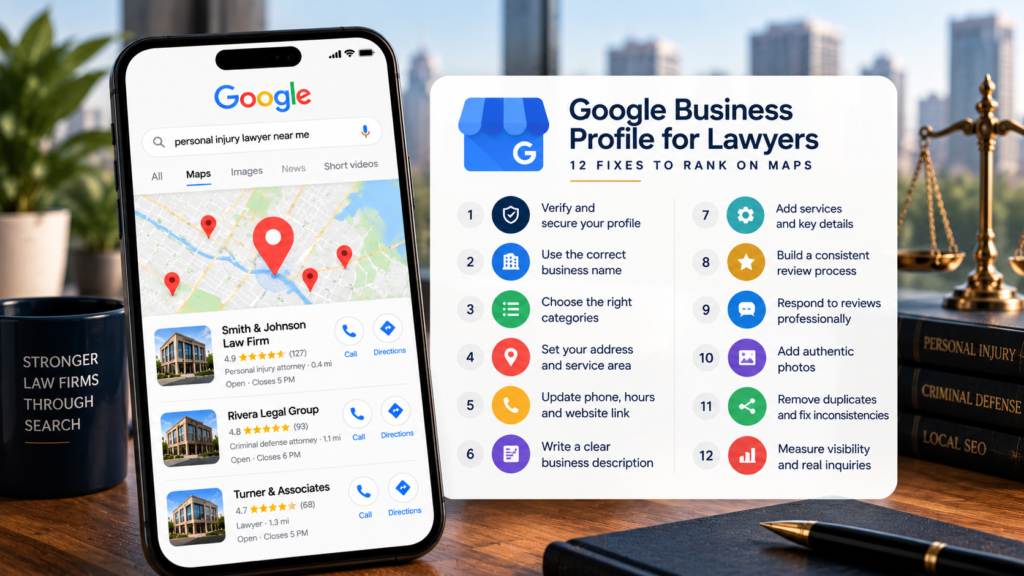
For firms that serve a defined area, map results are often where a prospective client first sees the firm. A local audit should review both the Google Business Profile and the website pages that support it.
Google Business Profile
Check that the profile:
- Is verified, with the firm as primary owner
- Uses the firm's real name, with nothing added to it
- Has the correct address or service-area setup, hours and phone number
- Uses an accurate primary category and relevant secondary ones
- Links to the most relevant page on the site
- Has a routine for requesting and responding to reviews
- Follows Google Business Profile policies
Google names relevance, distance and prominence as the main factors in local results. A complete profile helps Google understand the firm. It doesn't guarantee a position.
Visibility beyond your firm's name
People who search your firm's name already know you. The searches that show real reach are a service plus a place, with no firm named. Review those for each priority service and office, and record the search, location, date and what appeared.
Map results change with where the searcher stands, so one screenshot taken from your office proves little. Check from several points across your service area.
Also review location pages, business details on major legal directories, reviews and local links or mentions. Avoid dozens of near-identical city pages. Each location page should give people in that area something useful.
Tie local visibility to calls
Profile views and direction requests are context, not clients. Where records allow, compare local activity with calls, form inquiries, consultations and new clients, and check that calls from the profile are tracked consistently.
What you should come away with: how the firm appears in the local searches that matter, which issues to fix first and what you can reliably measure. See how we approach local SEO for law firms.
5 AI search visibility: what's real and what's sales talk
AI Overviews, AI Mode and other answer tools now sit alongside search results, so it's fair to ask how your firm appears in them. This is also where agencies are most tempted to oversell.
Google's guide to optimizing for generative AI features, updated in July 2026, says those features are built on its core ranking and quality systems, so SEO best practices still apply. It treats "GEO" and "AEO" as part of SEO, not a separate discipline.
What a sound audit checks
- Eligibility. Pages must be indexed and able to show with a snippet. Google's guide also says the site must be included in generative AI features in its Search Console settings.
- Original content. Google contrasts generic, common-knowledge content with first-hand expert content. For a law firm, that means pages written or reviewed by the lawyers who handle the matters, not recycled tips.
- Clear facts about the firm. The site should state plainly who the firm is, what it does, where and who its lawyers are. A complete Google Business Profile matters here too, since AI responses can include local business details.
- Measurement. Search Console's Generative AI performance report shows how your content performs in Google's AI features.
What Google says you can ignore
For Google Search, its guide lists things site owners don't need to do:
- Create llms.txt files or other special "AI" files and markup
- Break content into small "chunks" for AI
- Rewrite pages in a special style just for AI
- Pursue inauthentic mentions across the web
- Add special schema markup for AI features
These are Google's statements about Google Search. Other AI tools work differently and change often, so apply the same skepticism to claims about them.
Test, record and say what's uncertain
Pick questions your prospective clients actually ask. Check them in the AI tools that matter to your market and record the question, date, tool, answer and any sources cited. A few screenshots don't prove broad visibility, because answers vary by question, tool and day. The audit should say what was checked, what appeared and what can't be measured yet.
What you should come away with: a grounded view of where the firm stands, fixes based on fundamentals and a plain list of what remains uncertain. Here is how we handle AI search visibility for law firms.
6 Measurement and intake: can you connect search to new clients?
This is where an audit stops being a technical exercise and becomes a business tool. Rankings and traffic explain search performance. They don't show whether the firm is winning the right work.
Follow the whole path
- Visibility: which searches and pages appear
- Visits: which pages bring people in from search
- Inquiries: which calls, forms and chats come from prospective clients
- Qualified inquiries: which meet the firm's intake criteria
- Next steps: which become consultations or pitch invitations
- New business: which become signed cases or new matters
A consumer-facing firm may count calls, consultations and signed cases within days. A business-facing firm may track pitch invitations and new matters over months. Use the firm's own definitions and records, and say so where records are incomplete rather than presenting estimates as results.
Test intake, not just tracking
Search can only produce clients if someone answers. In Clio's 2024 secret-shopper test, 40% of law firms answered a prospective client's call, down from 56% in 2019.
A useful audit tests the firm's own intake: call during business hours and after hours, submit the website form and time the reply. If inquiries go unanswered, more traffic won't help.
Tracking you can trust
- Search Console and analytics, set up correctly
- Form submissions and calls each recorded once, not counted twice
- Call tracking set up so the firm's phone number stays consistent on Google and legal directories
- A source field in the intake or client management system
- A routine record of which inquiries became clients or matters
Protect confidential client information. Share only what the review needs, with appropriate permissions. Where several channels contributed to a new matter, don't credit SEO alone.
Run the numbers
Here is a simplified, hypothetical example. It is not a Serptone Legal client result or a forecast.
| Monthly SEO fee | $5,000 |
| Average fee per signed case | $4,000 |
| Profit margin on that work | 50%, so $2,000 profit per case |
| Break-even | $5,000 ÷ $2,000 = 2.5, so three additional signed cases a month |
That is before timing, capacity and other costs. Use your firm's own numbers, and ask whether those cases would have come in anyway. The point is that SEO reporting should help a firm make a business decision, not celebrate a rise in traffic.
What you should come away with: what your current tracking can prove, where the gaps are and how future SEO work will be judged in clients and dollars.
How we approach an audit
Our view is simple: rankings are a means and new clients are the end. That's why our audits finish with intake and measurement, not with a keyword list.
Example: turning one finding into one action
Take a hypothetical firm whose main practice area page appears in search often but produces few recorded inquiries. A weak audit recommends a rewrite. A stronger one follows the evidence.
| Step | What the auditor does |
|---|---|
| Identify | Notes the page appears for relevant searches but produces few recorded inquiries. |
| Verify | Checks Search Console queries, page content, internal links, the contact path and intake records. |
| Diagnose | Finds the cause: the wrong searches, an unanswered question, a weak contact path or a tracking gap. |
| Prioritize | Fixes what the evidence supports, which may not be the copy at all. |
| Measure | Records the baseline, makes the change and reviews inquiries over an agreed period. |
The first finding doesn't prove the page is badly written. That is the standard to expect: not a list of problems, but a defensible reason for each next step.
Warning signs of a weak law firm SEO audit
It doesn't ask who owns your accounts
An audit that skips ownership leaves the firm's biggest risk unchecked.
It lists errors without ranking them
A spreadsheet of warnings is not a strategy. The report should say which issues affect important pages or business goals, which can wait and why.
It treats every ranking as equal
A broad informational ranking is rarely worth as much as visibility for someone choosing a firm. Priorities should follow the firm's practice areas and case economics, not search volume alone.
It recommends more content before reviewing what exists
Existing pages may be outdated, overlapping or aimed at the wrong search. Fix those before commissioning a large content plan.
It sells AI shortcuts
Special AI files, "chunked" rewrites and bought mentions are on Google's list of things site owners don't need for Google Search. Ask what evidence supports any AI recommendation.
It reports traffic without checking intake
More visits don't mean more qualified inquiries. A credible audit compares website activity with intake records and explains the gaps.
It promises results before setting a baseline
No responsible audit can guarantee a ranking, inquiry volume or number of signed cases. A forecast should state its range, assumptions and time frame.
What you should receive after an audit
- An executive summary of the most important findings in plain English
- An ownership and access list covering every account
- Evidence behind each major recommendation: the pages, reports or examples
- A ranked list of priorities, with what can wait
- Recommended actions: what should change, why and who does the work
- Local findings on the profile and local visibility
- An AI search review: what was checked, what appeared and what remains uncertain
- A measurement and intake review: what can be measured now and where it breaks down
- A next-step plan with order of work and dependencies
The report should separate verified findings from hypotheses. Ask whether the provider will walk you through it and answer questions.
Seven questions to ask any SEO agency, including us
- What evidence supports each recommendation? A tool warning is a reason to investigate, not proof that a change is needed.
- How will you decide what to fix first? The answer should connect technical issues, content, local visibility and business goals, not a checklist used on every site.
- What will you measure, over what period and from what source? Ask for the baseline and a definition of each metric. Early technical progress and new clients run on different timelines.
- How do you evaluate AI search visibility? Ask which tools and questions are checked, how results are recorded and whether the approach matches Google's own guidance.
- Who owns the website, content and accounts, during and after the engagement? Get it in writing.
- What will you need from our team? Agree who supplies information, approves content and makes technical changes.
- What are the contract and exit terms? Understand scope, cost, cancellation and what you keep if you leave.
Google's own guidance on hiring an SEO also recommends checking references, asking how success will be measured and walking away from anyone who guarantees a first-place ranking.
What should happen after the audit
The order depends on the findings. A site with blocked pages needs different work from one with sound foundations and thin practice area content. A typical sequence:
- Secure ownership and access. Move every account into the firm's control.
- Fix critical indexing problems. Make sure priority pages can be found.
- Close measurement and intake gaps. Set the baseline before changing anything else.
- Improve priority pages. Start with the services and offices that matter most.
- Strengthen local visibility. Correct the profile and the pages that support it.
- Monitor AI search and reassess. Review results over an agreed period and update priorities.
Some technical fixes show within weeks. Gains in new clients take months, not weeks, and usually longer for business-facing firms. Any forecast should state its assumptions and time frame.
Start with a free audit
Serptone Legal works only with US law firms. Our free audit checks what the main AI tools say when asked about your practice areas in your city, which firms they name and what they say about yours. It includes a 30-minute strategy consultation. It is confidential and carries no obligation.
A useful first conversation should clarify:
- Which practice areas and locations matter most to your firm
- Whether your website and public information have identifiable issues
- How you currently track qualified inquiries, consultations and new matters
- Which improvements deserve priority and how progress can be evaluated
You will leave with a clear assessment of what needs attention. You will not get a promise of rankings, or that an AI platform will recommend your firm.
Frequently asked questions
How much does a law firm SEO audit cost?
It depends on the size of the site, the number of practice areas and offices, and how deep the review goes. Some providers offer an initial audit free and charge for a full technical and business review. Confirm what is included before you agree to anything.
How long does a law firm SEO audit take?
It depends on the site, the scope and how quickly access is granted. Ask for a delivery date, a list of what the provider needs from you and whether a review meeting is included.
Can an SEO audit guarantee better rankings?
No. An audit can find problems and opportunities, but no one controls how Google ranks a page. A credible provider explains the evidence behind each recommendation and the assumptions behind any forecast.
Should Google Maps and the website be audited separately?
Review them as distinct parts, then together. The Google Business Profile drives map visibility, and the website supports it with detail about the firm's services and offices.
Does a law firm need a separate AI SEO audit?
Usually not. Google's guide to generative AI features says its AI features rely on its core ranking systems and that optimizing for them is still SEO. AI visibility can be reviewed as part of a full audit.
What access should an SEO auditor get?
Only what the review needs. Google recommends granting read access to Search Console during an audit, not write access. Confirm account ownership and data handling before sharing anything.
How often should a law firm audit its SEO?
There is no fixed schedule. An audit is most useful before a website redesign, after major site changes, when important pages lose visibility or when the firm can't explain what its SEO spend is producing.
Sources
- Google Search Central: Optimizing your website for generative AI features on Google Search (updated July 2026)
- Google Search Central: Do you need an SEO? (updated June 2026)
- Google Search Central: Technical requirements
- Google Business Profile Help: Tips to improve your local ranking
- Search Console Help: Generative AI performance report
- ABA Law Practice Magazine: Law's new first impression: transforming client intake (March–April 2025, citing Clio's 2024 Legal Trends Report)
This article is general information about SEO, not legal advice. Attorney advertising rules vary by state and change over time. Consult your state bar or ethics counsel about your firm's advertising obligations.